
In 2007, investment bank Merrill Lynch swung from a bottom line profit of US$ 7.5B in 2006 to a bottom line loss of US$ 7.8B, while its competitor Morgan Stanley’s net income more than halved, from US$7.5B to US$3.2B. And yet, over the same period, Goldman Sachs managed to increase its profits by 21.6% to a record US$ 11.6B. (Lehman Brothers also eked out a 5% increase, turning a profit of about US$ 4B—but unlike the other institutions, it would cease to exist in 2008.) According to Thomson Financial league tables, Goldman retained its #1 crown in Mergers & Acquisitions, advising on US$ 1,340B in worldwide announced deals with a dominant 27.7% market share. Since time immemorial, the bank was the smartest and hardest working of them all.
Be that as it may, on 23 September, 2008 and working on their own behalf, these expert deal-makers raised US$ 5B in capital it didn’t seem to need, paying the counterparty more than they rationally should. That counterparty was Berkshire Hathaway, the holding company built by Warren Buffett. It was the sort of deal that gives texture to eras that get recorded in the financial history books with their own three letter acronym.
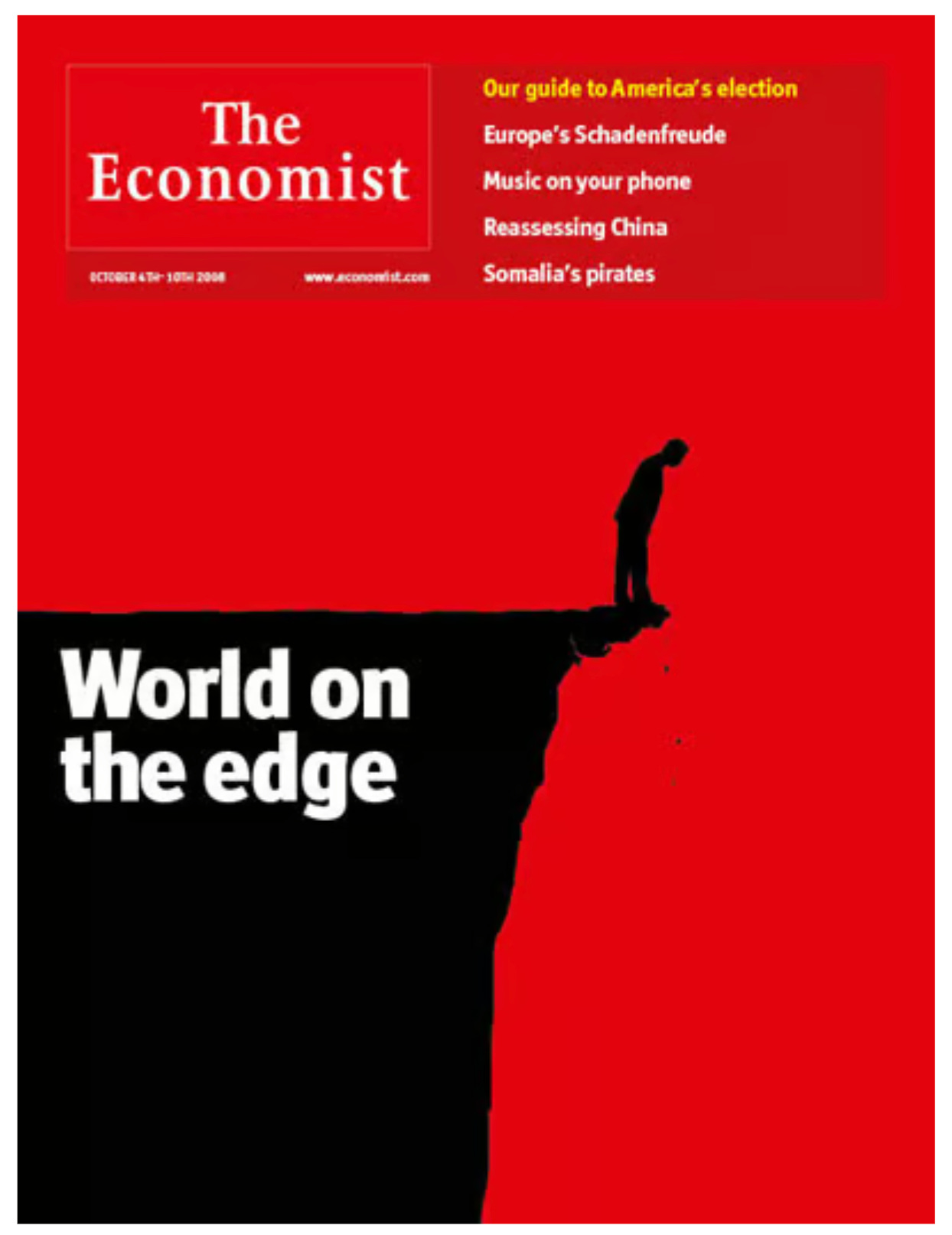
On 7 September, the federal government had seized Fannie Mae and Freddie Mac, the two government-sponsored mortgage giants that between them owned or guaranteed half the residential mortgages in America. Their business was buying mortgages from banks, bundling them, and selling the bundles to investors, backed by an implicit — now explicit — federal guarantee. Fannie and Freddie’s collateral had never been tested. On this Sunday it was, and it was found lacking. The regulator handed them over to be run from Washington, reducing their shareholders to spectators.
On 15 September, at 1:45 am on Monday morning, Lehman Brothers filed for bankruptcy. 158 years in continuous operation since its foundation by Hayum, Emanuel and Mayer Lehman in Montgomery, Alabama, the firm started by financing and trading cotton, the largest cash crop in the state. It had survived the panic of 1893, when a run on gold supplies caused a massive collapse in railroad stocks and bank failures across the country. It had survived the Wall Street crash of 1929 and the ensuing Great Depression. It had survived the 1973 Oil Crisis, when the OPEC oil embargo caused a prolonged bear market and Lehman, hard hit by trading losses, brought in outside leadership and merged with Kuhn, Loeb & Co. to stabilize its capital base. It survived the Asian financial crisis of 1997 and the collapse of hedge fund LTCM in 1998. It did not survive the Great Financial Crisis of 2008, going out of business with US$ 613B in debt.
On 16 September, the Federal Reserve extended US$ 85B to keep American International Group in operation, an insurer most customers associated with homeowner’s policies and annuities. AIG’s trouble had nothing to do with fender-benders or fire damage. A small London subsidiary, AIG Financial Products, had somehow written US$ 441B in credit default swaps — insurance contracts, sold against the possibility that bundles of mortgage debt would go bad. The bundles had gone bad, and AIG discovered it could not pay. “Progress is cumulative in science and engineering, but cyclical in finance”, observed financial journalist James Grant. The world painfully rediscovered, with new case studies emerging every day, that a guarantee is worth only as much as its guarantor.
In most industries, the collapse of a competitor is good news. Not so in banking. Goldman Sachs CEO Lloyd Blankfein heard about the imminent collapse of Lehman Brothers on Friday 12 September. U.S. Treasury Secretary Hank Paulson gathered the Wall Street bank CEOs at the Federal Reserve Reserve Bank of New York on Liberty Street, a heavy rain pouring outside as an unpleasant storm front moved through the Northeast shutting down even Major League Baseball. He informed the sweating audience Lehman was in a “precarious position” (no news to anyone), that a solution would need to be found over the weekend, and that that solution would not involve government money. Throughout the weekend, Blankfein had several more concerned calls with Paulson, his predecessor as Goldman Sachs CEO, the latter insisting the general public and Congress had no appetite for bailouts. Blankfein didn’t fear a run on his bank—but what would such confidence be worth during a run on all banks?
To survive, a bank needs to be strong, and be perceived to be strong. Managing and derisking the balance sheet was business as usual for Goldman Sachs’s trading desks at 200 West. The more interesting managerial head scratcher was altering the perception that Goldman Sachs was a financial institution like any other, and therefore a financial risk like any other. The question was pertinent, as the investing public was definitely throwing out the Goldman baby with the Wall Street bathwater. At market close on Friday 12 September, a share of Goldman changed hands at $154.21; on Tuesday 16 September that same share could be had for $86.31.
“What happened (…) was a crisis of confidence driven by rumors, but our liquidity model is fundamentally different. We have a liquidity pool of nearly $45 billion. We have completed our budgeted funding plan for the full year of 2008. We are not reliant on short-term unsecured funding in the way the market fears. We are actively managing our risk down.”
Those are not the words of Lloyd Blankfein, on 15 September. They were spoken by Richard Fuld, Lehman Brothers CEO, on 15 April, at the occasion of the Annual General Meeting. Fuld made these statements in response to the recent collapse of another bank, Bear Stearns, and the ensuing crisis of confidence it instilled in his shareholders.
Every pyramid has a top. In the hierarchy of trust and finance, that top is Berkshire Hathaway. When Warren Buffett took control of the company in 1965, it was a struggling textile mill worth US$ 22M, with no cash and US$ 2.5M owed to the banks. He diverted cash to more profitable investments, eventually shut down the textile operations (but never let go of the company name), and by 2007 turned it into a conglomerate worth US$ 219B, sitting on a cash position of US$ 39B. When legendary investors like Bill Ackman or Seth Klarman are asked who they admire, the consensus answer is Buffett is the greatest of all times.
Not that Buffett’s track record never met criticism or resistance—if not outright ridicule. “What’s wrong, Warren?” asked the 27 December, 1999 cover of Barron’s. The magazine frowned at Buffett missing out on the gains in internet stocks, in a year Berkshire shed 23% while the S&P500 index rose 18%. “Warren Buffett’s still golden touch”, the same magazine bowed its head in 2003, after the air had come out of the internet bubble. Between the Barron’s cover and the Goldman deal, Berkshire Hathaway had become 50% more valuable. Its balance sheet was the corporate equivalent of Fort Knox. Then too, it helped that Berkshire was no bank.
Berkshire Hathaway and Goldman weren’t strangers to each other. Buffett had a personal connection to the bank since 1940, the year he was 10 years old, Kim Philby rose through the ranks at MI6, and Churchill was corresponding with Roosevelt on what would become the Lend-Lease deal. On a trip to New York City, Omaha-based broker Howard Buffett took his son to the offices of Goldman Sachs. They dropped in unannounced to see Sidney Weinberg, the already legendary senior partner who rebuilt the firm’s reputation after the 1929 crash. Weinberg made time to receive them in his office for a 30-to-45-minute conversation. As they were leaving, he put his arm around the young Buffett and asked: “What stock do you like, Warren?” Buffett later recounted this story to his biographer, Alice Schroeder, for her book The Snowball. He noted that while Weinberg “had forgotten it all the next day,” Buffett himself “remembered it forever.”
The promising spark notwithstanding, what blossomed between Berkshire and Goldman Sachs wasn’t based on romance. Buffett’s professional relationship with the firm started in the late 1960s, when he needed to place idle cash in his pre-Berkshire investment partnership and bought short term commercial paper with the then market leader as his broker. That didn’t mean he grew fond of investment banks and investment bankers. Berkshire’s 2014 annual letter to shareholders summarizes his view on the profession and its practitioners.
“Investment bankers, being paid as they are for action, constantly urge acquirers to pay 20% to 50% premiums over market price for publicly-held businesses. (…) A few years later, bankers – bearing straight faces – again appear and just as earnestly urge spinning off the earlier acquisition in order to “unlock shareholder value.”
The one post-Weinberg exception was another Goldmanite. In the 2003 shareholder letter, Buffett wrote a named accolade to Byron Trott, who he had worked with since Trott pitched him the sale of Ben Bridge jewelry in 2000.
“I should add that Byron has now been instrumental in three Berkshire acquisitions. He understands Berkshire far better than any investment banker with whom we have talked and – it hurts me to say this – earns his fee. I’m looking forward to deal number four (as, I am sure, is he).”
Standing out like an honest banker.
When Goldman Sachs pursued a financing deal with Berkshire, the endorsed and vindicated Trott was the only credible candidate to act as their negotiation agent. Unlike the 1940 encounter, the 2008 plane trip went from New York to Omaha. Trott would later give a succinct summary of the mandate Blankfein entrusted him with, when he testified as a witness in a 2012 insider trading trial. (A Goldman Sachs board member tipped off a hedge fund manager immediately after the meeting where he heard the Berkshire deal would go through) Trott’s marching orders were as follows: “They gave me the latitude to negotiate any deal that I could.” Some negotiations require no other skills than the ability to take detailed notes.
The 23 September 2008 joint Goldman / Berkshire press release summarized Buffett’s terms.
“New York, NY - September 23, 2008 -- The Goldman Sachs Group, Inc. (NYSE: GS) announced today that it has reached an agreement to sell $5 billion of perpetual preferred stock to Berkshire Hathaway, Inc. in a private offering. The preferred stock has a dividend of 10 percent and is callable at any time at a 10 percent premium. In conjunction with this offering, Berkshire Hathaway will also receive warrants to purchase $5 billion of common stock with a strike price of $115 per share, which are exercisable at any time for a five year term.”
The fine print didn’t go in the press release or the 8-K SEC filing. The authorities stipulated that redemption of the preferred would be subject to approval from the Board of Governors of the Federal Reserve. Buffett added the condition that Blankfein, as well as co-COOs Gary Cohn and Jon Winkelried and CFO David Viniar, would not be allowed to sell their personal shareholdings as long as the Berkshire preferreds had not been redeemed. Goldman added a similar clause that did make it to the Ex-10.1 Securities Purchase Agreement filed on 29 September: Berkshire Hathaway was not allowed to sell, reduce or hedge its financial exposure to Goldman Sachs. Not that Buffett was ever tempted.
Six months earlier, Buffett had been discussing a similar deal with another iconic investment bank: Lehman Brothers. On March 28 (a Friday), Dick Fuld and his CFO Erin Callan called Omaha to pitch Berkshire on investing. Buffett and Fuld had only met once before, at a 2007 Treasury dinner. Fuld said he wanted to raise between US$ 3B and 5B. Buffett proposed preferred shares with a 9 percent dividend. He also proposed warrants, with a $40 strike price (compared to the Friday close of $37.87). Spending the evening analyzing Lehman’s financial reports, Buffett already concluded he would not invest—too many open questions and red flags. In a Saturday morning follow-up call, it turned out there had been some confusion with regard to the warrants. Lehman had understood they would be struck at “40% above market”. Talking from their office in New York, Fuld terminated the discussions, commenting to Callan he considered Berkshire’s offer “preposterously expensive.”
Buffett’s 2009 annual letter to shareholders had this to say about the Goldman Sachs deal, and the business environment in which it was constructed.
“When the financial system went into cardiac arrest in September 2008, Berkshire was a supplier of liquidity and capital to the system, not a supplicant. At the very peak of the crisis, we poured $15.5 billion into a business world that could otherwise look only to the federal government for help. Of that, $9 billion went to bolster capital at three highly-regarded and previously-secure American businesses that needed – without delay – our tangible vote of confidence.”
One paragraph earlier, the same letter contained the following observation, capturing Berkshire’s philosophy in business and life:
“We will never become dependent on the kindness of strangers.”
When the press release went out on 23 September, Lloyd Blankfein first made sure even the slower minds in the industry would completely get the point. The Blankfein-attributed text referred to Buffett as “arguably the world’s most admired and successful investor”. With that setup out of the way, said admired and successful investor delivered on his side of the bargain:
“Goldman Sachs is an exceptional institution,” said Warren Buffett, Chairman and CEO of Berkshire Hathaway, Inc. “It has an unrivaled global franchise, a proven and deep management team and the intellectual and financial capital to continue its track record of outperformance.”
You don’t become an investment oracle being uneconomical with words.
The Berkshire deal added an immediate US$ 5B to Goldman’s US$ 111B in cash and liquid securities. The next day, the bank sought to raise another US$ 2.5B from the reassured general investment public. The offering was oversubscribed more than two times over, raising US$ 5.75B at $123 per share, eight days after the 16 September intra-day low of $86.31.
If Goldman Sachs was enthusiastic about its deal, that sentiment was not shared by everybody in the financial commentariat. Hedge fund manager Doug Kass said Buffett had operated like a “predatory lender of last resort”. Institutional market strategist Barry Ritholtz wrote “for Goldman Sachs, it is a very expensive deal. Warren Buffett extracted his pound of flesh (and then some).” It is unclear what alternative arrangement these pundits had in mind. No deal at all? Or perhaps a sweetheart deal, with gentler terms to Goldman Sachs? If that institution has a documented track record of kindness to strangers, we failed to locate it.
“Our preferred shares are paying $15 a second, so as we sit here, ‘tick, tick, tick, tick,’ that’s $15 every second… Recent developments have probably delayed the calling of our preferred for some time, so ‘tick, tick, tick’ will go on, and we’ll be getting $500 million a year… We love the investment.”
Thus observed Warren Buffett at the 1 May, 2010 Berkshire Hathaway annual shareholder meeting. The clock stopped ticking in April 2011, when Goldman Sachs redeemed the preferreds, not a moment later than the Federal Reserve allowed them. The parties subsequently renegotiated the warrants leg on their expiry date, 1 October, 2013. They were settled in a cashless transaction, exchanging the 43.5M warrants for 13,062,594 shares of Goldman common stock. Berkshire avoided the cash outlay required to buy the 43.5M shares outright, and Goldman limited dilution to no more than 13M new shares. The stock traded at $190 on that day. Total Berkshire profit from the deal clocked in at US$ 3.8B.
The abstract of the May 2009 Harvard Business School case study “Going to the Oracle” states:
“This case provides an opportunity to evaluate Goldman’s decision to raise capital, the cost to the firm of Buffett’s investment, and the decision by Warren Buffett to make the investment, all in the context of a profound market crisis that may have altered the usual metrics for such decisions.”
In March 2009, Byron Trott left Goldman Sachs. He raised US$ 2B to start his own firm. One of the early investors, taking a small stake, was Warren Buffett.
This essay reflects on Status, one pattern of the 27 that make up the Negotiation Pattern Language. Here is an overview of the framework, which distills thousands of deals and all literature on the topic, in a single logical structure.