
Why this Framework · Nine Cells · Twenty-Seven Patterns · Limitations · Applications
Why this Framework?
The problem with negotiation advice is not that there’s a shortage—there’s too much of it. It contradicts itself constantly, and both sides are usually right. “Always anchor first.” “Never make the first move.” “Show your constraints — transparency builds trust.” “Never reveal your limits — you’ll disclose information.” “Let them see you’re emotionally invested; authentic stakes are persuasive.” “Stay composed no matter what; emotions are perceived as weakness.” Each of these is sound counsel, coming from people who earned the insight doing the work. And yet, none of them is universally true. Context is everything.
Drop a metal disc from your hand and it will fall, because of gravity. Put the same disc in a strong enough magnetic field, and it will rise. Physicists don’t ask which one of these contradictory forces is “real,” nor do they look for a single one that is universally applicable. Instead, they analyze which forces are present and how strong each one is, to determine what the combined effect will be. Negotiations proceed the same way.
The analogy is not absolute. It would be nice to derive the different phenomena from universal laws, but that is not feasible. Atoms don’t have free will; human beings do. Still, if the Negotiation Pattern Language (NPL) can’t be built out of immutable laws, it can categorize the forces. It doesn’t declare one piece of advice right and its opposite wrong. Instead, it identifies the underlying patterns, under which conditions they apply and how they interact with other patterns. Appropriate here, ineffective there, and this is how you can tell the difference.
The moniker “pattern language” is adopted deliberately. It is terminology borrowed from architect Christopher Alexander’s 1977 book A Pattern Language. Alexander did for architecture what NPL does for negotiation: identify the frequently recurring problem/solution combinations, classify them in a coherent structure, governed by logical principles with real analytical and predictive power. Alexander observed the same atomic patterns showing up again and again, and recurring at different scales, in buildings, neighborhoods and cities. Individually, none of them was a rule to apply mechanically. And yet, collectively they covered the field. He has 253 of them in the book. Mercifully the NPL can make do with about 10% of that.
Negotiation and architecture both involve problems of analysis (”Why is this structure not working?”) and problems of design (”How do I plan this such that I don’t fall into the same trap I did last time?”) Nothing is ever really new in negotiation—and yet it’s always a little different. A fixed method or standard checklist won’t work when the opposite side is pushing back. A vocabulary of interacting patterns can. The building blocks are always the same; their combinations are not.
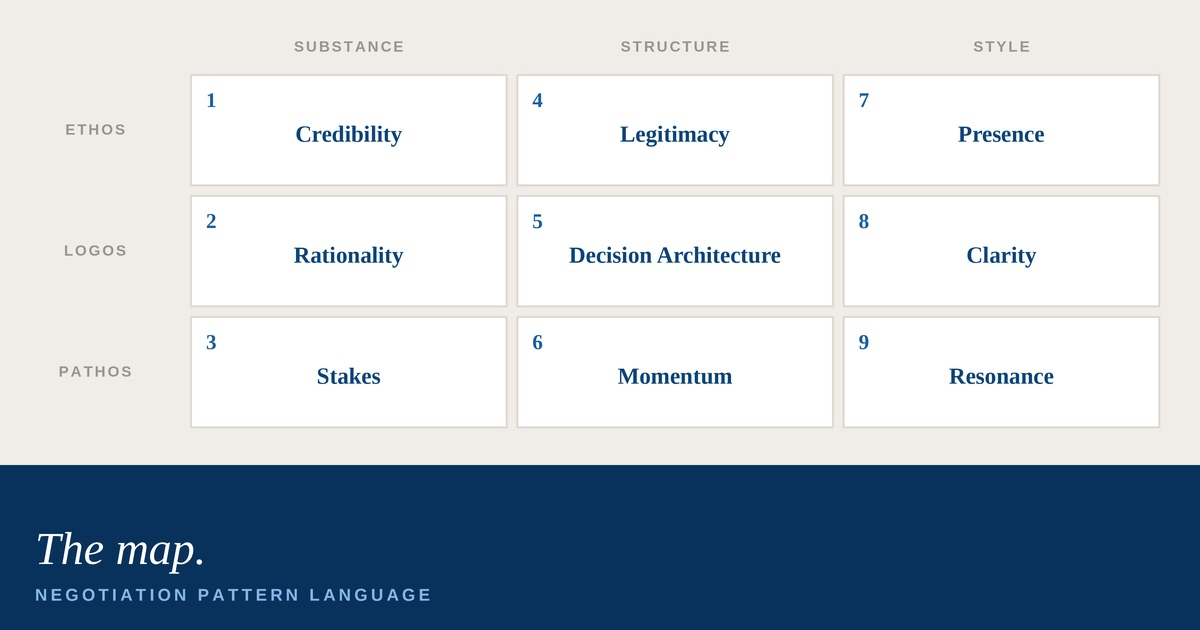
Concretely, the NPL consists of twenty-seven recurring patterns, organized in a 3 × 3 grid, with each cell tiled by 3 patterns. Collectively, the patterns cover any interaction of parties with the goal of forging agreement out of a set of divergent needs and opinions — from a hostage crisis to a grocery-store haggle to a corporate acquisition to a multi-national treaty. Context determines which tools you’ll need from this toolbox.
Built from simple first principles
The NPL framework is constructed on two axes. With a last wink to physics, one axis covers force and the other the locus that force attaches to. That also means the NPL doesn’t pretend to add any new material to the field. All it does is label, organize, and integrate existing material.
The axis covering force is adopted from Aristotle’s Rhetoric. In the context of negotiation, “force” refers to the power of persuasion and the core idea of reconciling different opinions and ideas, bringing the other side’s position closer to ours. The categories go back 2,000 years: Ethos, Logos, and Pathos. Ethos is the category in which persuasive power originates in the source: the credibility of the person making the case, independent of argument and in place before any is even made. Logos grounds it in the message: the internal soundness of the argument itself, independent of who is delivering or receiving it. Pathos operates in the receiver: the state the argument produces in the listener, independent of the argument’s strength or who uttered it.
These three are always simultaneously present to some degree. There is no such thing as a purely logical exchange between two people. The moment there is a speaker, Ethos is in play. The moment there is a listener, Pathos is in play. All three operate independently of each other. A logically flawless argument can still go nowhere if it comes from a distrusted source. A trusted source can deliver a logically airtight case and still leave an audience emotionally unmoved. Aristotle’s set is orthogonal: each element can be active to a greater or lesser degree, but they never collapse onto each other.
The second axis covers the three domains of a negotiation where force can move something: Substance, Structure, and Style. Substance is the content of what is being offered, claimed, or fought over. Structure involves the process the parties follow and the architecture by which they construct the deal: the sequence of discussion topics, the selection of issues that are considered in and out of scope, the rules and constraints determining what actors are allowed to commit, and the description of what parties have agreed will be executed. Style addresses the modes of communication and interaction: how substance and structure actually reach the other party in the moment of exchange, regardless of how good the content or architecture is.
Combining the two axes creates nine cells, distinct categories that collectively give a home to every aspect of any negotiation.
The Nine Cells
These are the nine genuinely distinct cells of the Negotiation Pattern Language, with a headline description of what each one uniquely covers.
CELL 1 Credibility Ethos × Substance
Whether this specific actor’s statements deserve to be believed, and their behavior trusted. A question about the source, not the content.
CELL 2 Rationality Logos × Substance
Whether the argument, taken on its own merits, withstands scrutiny. Sound premises, valid chain of logic, coherent conclusion.
CELL 3 Stakes Pathos × Substance
The complete, existential cost of agreeing and committing. What a person would have to forego, expressed in different forms of currency, including the ones that can’t be priced.
CELL 4 Legitimacy Ethos × Structure
Whether a “yes” is properly authorized, procedurally sound, and durably binding — regardless of how sincerely it was expressed.
CELL 5 Decision Architecture. Logos × Structure
How the issue space gets defined, options get evaluated against decision criteria, and narrowed into a single outcome.
CELL 6 Momentum Pathos × Structure
How heavy, rushed, and final a decision feels, as a direct consequence of how the process is designed or executed.
CELL 7 Presence Ethos × Style
How an actor is perceived in the live exchange, moment to moment, and distinct from their historical record.
CELL 8 Clarity Logos × Style
What happens when an argument is transmitted from one mind to another. Whether it can be received and correctly weighted.
CELL 9 Resonance Pathos × Style
How the intensity, target, and timing of the receiver’s emotions evolve during the live exchange.
The Twenty-Seven Patterns
Each cell is covered by three distinct patterns. Individually each is genuinely different; collectively they tile the entire cell. How they tile is unique to the cell: according to a past/present/future split, such as with Cell 1, or an intensity/vector/temporal location structure like Cell 9. Below is one sentence per pattern. More detailed material, such as diagnostics and failure modes, is the subject of specialized write-ups, or integrated in specific applications.
Cell 1 — Credibility
1.1 Track Record
The documented history of what an actor has committed to and delivered, used to predict future behavior.
What have you actually done?
1.2 Status
Credibility drawn from the position an actor currently occupies in a relevant hierarchy, inspiring trust because the system around them disciplines and enables their behavior.
What standing do you have, and does the system behind you back it up?
1.3 Collateral
Trust built on what an actor stands to lose elsewhere if they defect here: deterrence, not a prediction from history.
What would defecting here cost you elsewhere?
Cell 2 — Rationality
2.1 Ground Truth
The shared, factual and testable foundations, serving as the basis for honest comparison of options.
What is verifiably true and real here, as opposed to a position, forecast, or narrative?
2.2 Relative Advantage
The logic of comparative preference; every option, including walking away, evaluated against what else is available.
Preferable compared to what?
2.3 Structural Integrity
Whether a deal’s internal logic stays coherent across the full range of conditions it will actually face — including the ones nobody anticipated.
Will the deal’s logic hold under stress it wasn’t built for?
Cell 3 — Stakes
3.1 Identity
A constraint that shrinks the choice set before logical evaluation even starts; the line between what merely hurts and what feels unsurvivable.
Would the self that agrees to this still essentially be the self that walked in?
3.2 Loss
The felt experience of deprivation, distinct from calculated risk, that filters and degrades rational evaluation.
What does this party fear losing, feel entitled to, or is trying to avoid?
3.3 Aspiration
The experienced pull of a desired and credible future state.
What does this party want to become, and can they see a credible path there?
Cell 4 — Legitimacy
4.1 Mandate
The authorization structure that determines whether an agent’s commitment binds the principal they represent.
Who has the authority to commit whom, to what?
4.2 Non-Arbitrary Procedure
Process rules that are stated in advance and applied consistently, independent of who they currently favor.
Are the rules of this process fixed in advance and applied the same way regardless of who benefits?
4.3 External Enforcement
Third-party authority that converts an agreement into a durable obligation after the negotiation itself has ended.
What makes this commitment binding, even against a party’s own future preference?
Cell 5 — Decision Architecture
5.1 Issue Decomposition
How the negotiation object gets divided into itemized, discussable elements — and, equally important, what gets left off the list.
What is in scope, and what has been excluded?
5.2 Decision Criteria
The evaluation function that turns an issue space into judgments about which outcomes are better, worse, or unacceptable.
By what logic do we choose among the options in front of us?
5.3 Convergence Mechanism
The series of steps narrowing down the option space to a single outcome.
What makes this process stop and actually produce a decision?
Cell 6 — Momentum
6.1 Load
The aggregate cognitive and emotional burden the process imposes on a party at a given moment.
How much of this do I have to carry right now?
6.2 Velocity
The rate at which the process forces interaction, evaluation, and commitment.
How fast must I decide?
6.3 Reversibility
The cost, formal or social, of revising or undoing a decision.
How costly would it be to reverse this if it turns out to be wrong?
Cell 7 — Presence
7.1 Transparency
The craft of calibrating disclosure: what becomes visible, to whom, and when.
What is revealed here, and what is deliberately concealed?
7.2 Consistency
Whether an actor’s words and actions, across different channels and over time, line up closely enough to give a stable, predictive picture of their intent.
Does their behavior match what they say?
7.3 Composure
Whether an actor’s signaling under pressure accurately reflects their inner state.
Does the signal under pressure still represent the stated truth?
Cell 8 — Clarity
8.1 Legibility
Whether the structure of an actor’s reasoning can be followed and reconstructed by the other side.
Can the counterparty follow my reasoning in their own terms?
8.2 Proportionality
Whether the expressed weight given to a statement matches the weight it actually deserves.
Is the emphasis I’m giving this proportional to what it’s worth?
8.3 Responsiveness
Whether an argument connects to what the counterparty already understands, rather than forcing them to translate it first.
Does this land in terms they already know and use?
Cell 9 — Resonance
9.1 Charge
The intensity of emotion in the exchange, independent of what it is about or when it surfaces.
How emotionally charged is this exchange, right now?
9.2 Direction
What or whom the emotion is pointed at, and whether that attribution is accurate.
What is this feeling actually being aimed at, and is that aim correct?
9.3 Placement
The timing of an emotional signal within the arc of the negotiation; when it surfaces, or is deliberately withheld.
When does this surface, and who has to process this?
Limitations
It cannot tell you what your goals are. Goals are an input to the process, not an output of it. NPL can’t tell you what a good outcome looks like or what you should value. At most, it can point out where your stated goals are structurally incoherent.
It doesn’t tell you whether you should negotiate in the first place. Arbitration, litigation, unilateral action, war — those are legitimate alternatives outside of the NPL’s scope. The framework only has something to say if negotiation has been decided upon as the chosen format.
It doesn’t guarantee outcomes. Every negotiation involves one or more counterparties, who may or may not cooperate, or even actively resist. The NPL can guide on offensive and defensive strategies, and predict which ones are likelier to work—but it can’t guarantee how other parties will behave.
It’s descriptive, not normative. NPL names how negotiation actually works, including the elements that are uncomfortable, aggressive, or outright unethical. Those patterns are named without comment on their ethics, because someone who can’t recognize a move can’t defend against it. Naming is not endorsing — let alone encouraging.
Applications
The pattern language has use cases before, during, and after a negotiation. Some of those are generic, reusable across many situations; others are specific, built for one particular engagement.
Training. (Before; Generic.) Reading a book against the framework, or mapping a case study onto the patterns, illuminates in what areas it has strong material, and which ones it doesn’t cover. The corpus also works in reverse: a student can start from one particular pattern to identify which material is worth studying next.
Strategy and planning. (Before; Specific.) Generic counterparty profiles, such as how Automotive OEM procurement typically negotiates, can be enhanced into a maintained file on a specific, regularly encountered counterparty. More detailed still, these break down to the level of distinct counterparty factions, drawing on the offense and defense material behind each pattern, plus a library of pattern combinations. Combined with the specifics of a next engagement, these get translated into playbooks, with scenarios fleshed out in advance, and rehearsal and role-play scripts to practice.
Real-time planning and coaching. (During; Specific.) Parsing what is actually happening as it is happening, in the same vocabulary used to prepare, and using the analysis to steer and coach in the moment. This covers deal desk infrastructure, and can include advice on the architecture of the agreement itself, as the deal begins to take shape.
Debrief and post-mortem. (After; Specific.) Analysis of what worked and what didn’t, expressed in standardized terminology, feeds forward into updated profiles and playbooks for future encounters with the same or a comparable counterparty.
Learning. (After; Generic.) The same discipline applied to the NPL itself: did anything happen that the framework hasn’t already accounted for?
This shows the map: the two axes, the nine categories, and all patterns in one or two sentences. Each of the twenty-seven patterns has companion pieces worked out in depth: what it is and isn’t, diagnostic signals and failure modes, how it’s used and countered. How patterns interact with each other in real world cases, and how it all distills into practical tools, is the subject of separate specialized content on this site, or bespoke advisory work.
Here is a two page reference sheet summarizing the entire map. Print it, laminate it, and share it with your friends.
