
Stefan’s take
The Louisiana Purchase, the United States acquiring one quarter of its current territory for $15 million from France, is often considered the best deal in history (especially by Americans). In reality, the U.S. got something different and the price was much higher. The phantom outcome is less fascinating than the true course of events. Agreement between the protagonists was impossible, until third parties made it inevitable. No participant stayed within mandate. The party with a looming deadline was not the one to feel its pressure. And if the deal needs a declared winner at all, it is a third party that usually goes unmentioned in the narrative.
Where this negotiation was decided — for better or worse
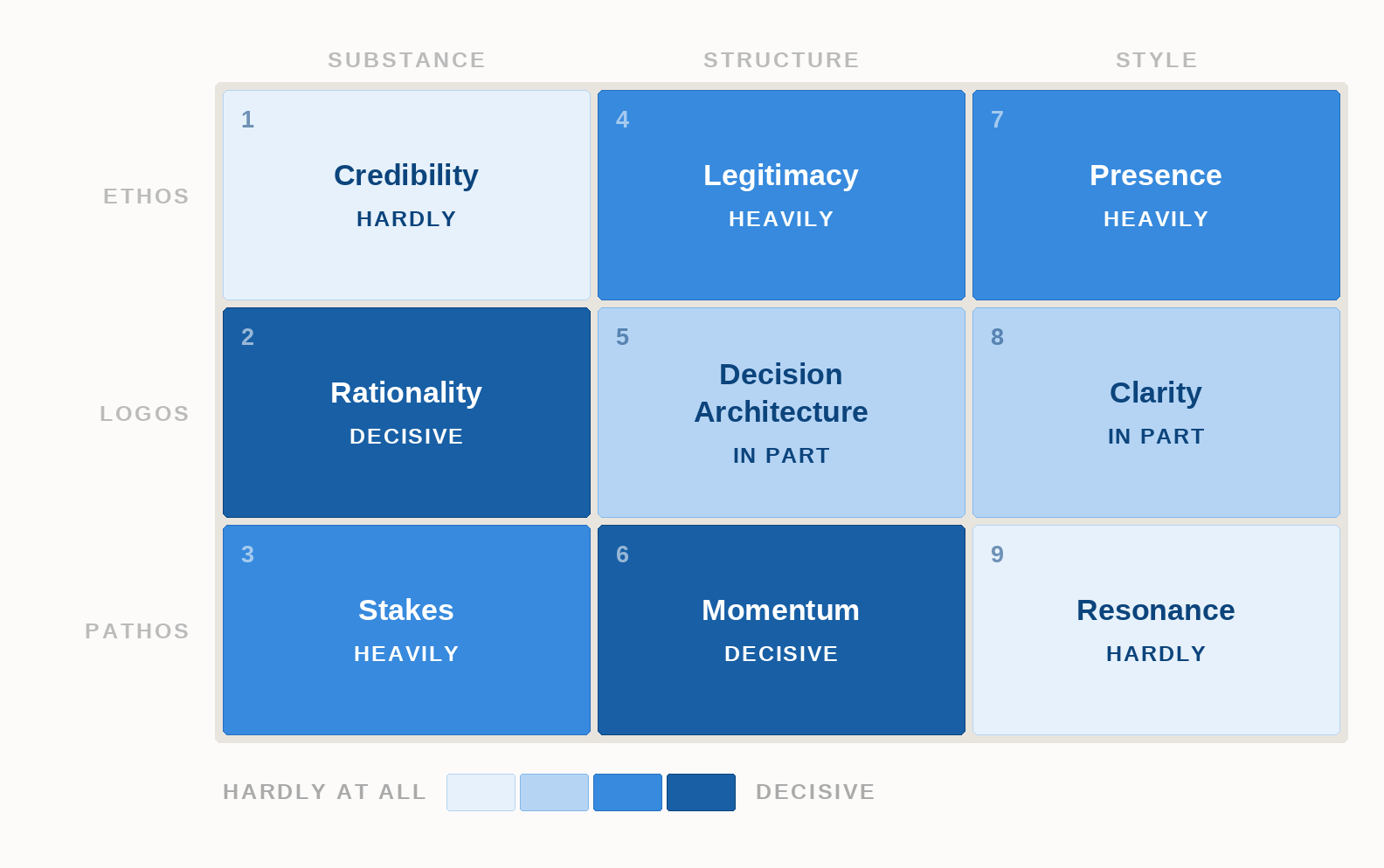
An unusual fingerprint. Neither decisive cell was controlled by either Napoleon’s France or Jefferson’s United States, the negotiating parties. An army in Saint-Domingue destroyed any rational reason for Napoleon to keep Louisiana. The British Royal Navy dictated the pace.
France — principal and agents
Napoleon Bonaparte, First Consul. Controlled the decision entirely, and to take it he overrode his navy minister, his foreign minister’s fifteen-month policy, and the terms of a secret treaty with Spain. He did not own what he was selling, and even said so.
François Barbé-Marbois, Minister of the Treasury, conducted the sale. Bonaparte chose him over Talleyrand because he was honest and knew America. Talleyrand, cut out, made the opening approach to the Americans anyway.
The United States — principal and agents
Thomas Jefferson, President. He defined the mandate and instructions, chose the envoys, and was the decision maker whether to send the result to the Senate. He wanted the Mississippi open and the western states quiet, without a war and (ideally) without breaking his own reading of the Constitution.
Robert Livingston, United States minister in Paris. Negotiating agent without leverage: there was no standing army to threaten with and the Treasury didn’t have the money to enlist the fifty thousand militia it would take to capture New Orleans. He answered directly to a president six weeks away, and indirectly to a Senate whose ratification wasn’t certain.
James Monroe, Minister Plenipotentiary and Extraordinary to France and Spain. A former minister to France and former governor of Virginia, nominated in January 1803 and popular in the west. Jefferson sent him as much to placate his own countrymen as to negotiate. From the day of the appointment, war rumors quieted down. He reached Paris on 12 April, the day after France had made an offer to Livingston.
Shaped it without negotiating
The army of Saint-Domingue — destroyed France’s reason to control Louisiana.
The Royal Navy — a latent threat to the American territory, and an immediate enemy in Europe.
Barings of London and Hope & Co. of Amsterdam — financed it, at a price.
The Federalist opposition in the Senate — whose war resolution reached Paris at the decisive moment.
Disposed of without participating
Spain — had a written veto on the sale, but could not enforce it.
The Osage, Kaw, Otoe, Quapaw, Caddo, Mandan, Arikara, Lakota and others — the only ones to actually live there, neither consulted nor informed.
How it unfolded
Robert Livingston arrived in Paris in the winter of 1801 with one instruction from Jefferson: secure American access to the Mississippi. Nearly the whole produce of the American west floated downriver to New Orleans. Whoever controlled that port controlled the entire hinterland economy. Spain had held it for forty years and could be relied upon to remain inert. France, on the other hand, could not. When rumors reached Washington that Spain had secretly handed Louisiana back to Bonaparte, the matter became more than commercial.
For fifteen months Livingston got nowhere. Hard of hearing, he spoke no French, and faced a foreign minister who would not concede that France had acquired Louisiana in the first place. He petitioned, argued, and at one point tried to bribe the Bonaparte family. In March 1803 he wrote home: “I fear nothing will be done here.”
Denying there was a need to do anything was official French policy. The cession was being discussed in the salons of Paris while the government, as Wilson Lyon relates in Louisiana in French Diplomacy, calmly disclaimed any knowledge of what was a notorious fact. When Livingston wrote in February 1802 asking directly whether the Floridas were included, Talleyrand drafted a reply of such scorn that it never mentioned Louisiana by name, submitted it to Bonaparte for approval, and advised the First Consul that if he did choose to acknowledge the cession, the acknowledgement should be verbal only. In the margin of the draft someone wrote: this note was not sent. Neither the scorn nor the confirmation ever reached Livingston.
Talleyrand maintained the policy as long as his master had a use for the colony, and not a moment longer. While Livingston was viewing the fifteen months as a negotiation he lost, the collapse of his counterparty’s position prompted them to start, at last. For France, Louisiana was to be the granary for Saint-Domingue, their sugar colony in the French Caribbean. Responding to a slave rebellion, an unsuccessful expedition sent to retake Saint-Domingue cost the lives of forty thousand French soldiers. Its commander, Bonaparte’s brother in law Charles Leclerc, died at Cap in November 1802. Troops assigned to occupy Louisiana were diverted to replace him. A backup force sat icebound in a Dutch harbor through January. In March, with war against Britain a certainty, the plan to send it was abandoned. Bonaparte was left holding title to a territory he had never occupied, could not reach and could not defend, at the moment it ceased being useful, and with his priorities urgently shifting to raising military funding.
On Friday 8 April, three things simultaneously arrived in Paris. American newspapers carried the text of Senator James Ross’s resolutions, proposing five million dollars and fifty thousand militia to take New Orleans by force. The French chargé in Washington sent word that Monroe, the new envoy, had carte blanche and would go to London if Paris rebuffed him. And Monroe himself came ashore at Le Havre. Livingston forwarded the Ross text to Talleyrand within hours and sent a French translation to General Bernadotte, who forwarded it to Joseph Bonaparte. That same day Talleyrand, who had blocked the sale for fifteen months, began calling it an advantageous arrangement against “the inevitable loss of a country that war was going to place at the mercy of another nation.”
By Barbé-Marbois’s own account, published twenty-six years afterward, Bonaparte came out of the Easter service at St. Cloud, summoned his treasury minister and his navy minister into the garden, and told them he was thinking of selling. He put the case plainly.
I can scarcely say that I cede it to them, for it is not yet in our possession. If, however, I leave the least time to our enemies I shall only transmit an empty title to those republicans whose friendship I seek.
Bonaparte at St. Cloud, 10 April 1803, as Barbé-Marbois recorded it in 1829
Decrès argued for keeping the colony. Marbois argued for selling. The discussion ran into the night, and both ministers slept at the palace. Marbois’ is the only surviving account of the evening — one in which his advice happens to prevail.
At daybreak Bonaparte sent for Marbois alone. He handed him dispatches just in from London, reporting British naval preparations under way at extraordinary speed. He waited while Marbois read, then closed the question. “Irresolution and deliberation are no longer in season. I renounce Louisiana. It is not only New Orleans that I will cede, it is the whole colony without any reservation.”
He put a floor under the price. “I want fifty millions for Louisiana, and for less than that sum I will not treat… I require money to make war on the richest nation of the world.”
His last instruction was to move before the second American envoy could reach Paris: do not await the arrival of Mr. Monroe; have an interview this very day with Mr. Livingston.
And yet, it was Talleyrand who sent for Livingston that afternoon, not Marbois. Cut out of the conversation at daybreak, the foreign minister worked his way back into it by lunchtime. He inquired whether the United States wanted all of Louisiana. Livingston, faithfully conveying his mandate, said no — New Orleans and the Floridas would do. Talleyrand observed that without New Orleans the rest was worth little, and asked what the Americans were prepared to pay for the whole lot. Livingston, suspecting a trap after fifteen months of zero negotiation progress, opened at twenty million francs.
The Americans had come to buy a port and two provinces. In one exchange and at the seller’s initiative, the object of discussion became a much larger part of the continent, one that would immediately double the size of the United States. The buyer didn’t object to the new scope. The subject matter thus silently settled, the only thing remaining was establishing the price.
Marbois misrepresented his instructions. Bonaparte had asked for fifty million; Marbois told Livingston that the First Consul demanded one hundred million. France owed money to American citizens: the United States assuming those claims would come on top. When Livingston recoiled, Marbois allowed himself to be brought down to sixty million francs plus twenty million in claims, presenting eighty as the least his principal would accept.
Madison’s instructions of 2 March had authorized Livingston and Monroe to spend up to fifty million livres — fifty million francs, in the currency the sale was actually priced in. That ceiling covered New Orleans and the Floridas, a fraction of what was now in scope. The buyer’s maximum mandate for a port and two provinces matched the seller’s minimum for a continent. Neither side ever found that out. On 29 April the Americans put their draft to Marbois: fifty millions to France, twenty more covering her debts to American citizens. Marbois refused. Anything under eighty in total would be useless to him, he said, “as the consul had been sufficiently explicit on that point.”
The consul had indeed been explicit — be it on a different number. A couple of bankers helpfully stepped in to bring the parties together on sixty million. Alexander Baring of Barings in London and Pierre Labouchère of Hope & Co. in Amsterdam had been in Paris throughout without participating directly in the discussions. By his father’s account Alexander was “largely responsible for reducing the French demands to so low a figure.” When Marbois pressed the Americans to advance something immediately, they confessed to having no money. Instead, they offered a financing plan through the European banks. The United States would hand France no cash but sixty million francs of American six percent stock, redeemable over twenty years. As France preferred something more tangible sooner, Barings and Hope again offered a solution. They took that paper off France’s hands for fifty-two million francs in cash, six million in the first month and two million a month thereafter. The bankers placed the bonds in London and Amsterdam at close to par.
You would think there were nothing but winners. Jefferson wanted New Orleans and got more than he bargained for — although he still had to negotiate a personal crisis of constitutional conscience and conduct several rounds of political haggling in Congress to get the deal ratified. (On 24 October 1803 it passed a first procedural test in the House 59 to 57, a two vote margin delivered by a three-to-one majority.) Bonaparte wanted fifty million francs and his minister got him sixty by pretending he had asked for a hundred. The banks took eight of that surplus ten off their hands, as the price of converting paper into gold. It seemed like the other side of the most celebrated negotiation in American history wasn’t such an unfortunate place to be.
Monroe and Livingston barely managed to get their signatures in, on 2 May 1803, before Britain and France resumed the war sixteen days later. Only in June did Francis Baring tell the British Prime Minister what his firm had done. Addington replied that he “saw nothing in our conduct but to approve” — indeed that Britain might wisely have paid a million sterling to move Louisiana from France to America. By December, he had changed his mind. He formally required Barings to stop remitting to the enemy, and to divert any French funds it could reach.
Barings complied with the instructions of their sovereign, and it made no difference. The London house sent Amsterdam a carefully phrased letter, “from a persuasion that our correspondence is watched.” Hope answered flatly: “We have no objection to the discontinuance of your Remittances as we shall not want them. But we cannot comply with the rest of your request.” Hope stood outside British jurisdiction and kept paying France.
On-schedule payments weren’t fast enough for Napoleon. Restructuring the deal in April 1804 with the ever creative and customer-friendly bankers, mostly in the person of Labouchère, France received accelerated instalments in exchange for a 1.675 million francs discount on Hope & Co’s total obligation. The proceeds bought shipbuilding materials in Russia for the French navy.
Albert Gallatin later put the two banks’ profit at three million dollars. The relationship between the houses soured over their joint win. Labouchère claimed he had originated the operation, and that a sixth of the profit was owed to Henry Hope in London; Hope’s own papers give the initiative to Alexander Baring. Francis Baring ended it by demanding half: “we claim as ‘a Right’ one moiety of the profits… We do not ask this as a favor, for we should think meanly of ourselves if we received a single penny as a concession or favor”. Hope pleaded the greater political risk. Baring answered that his own had been worse — “what I suffered can never be described and it completely overpowered my nerves for the first and I hope the last time.” The syndicate kept the loan documents in an iron chest at Hope’s offices in Amsterdam, secured with three separate locks, one key held by each house, so that none of them could open it alone.
The bonds stoically outlasted all the animosity. The United States paid promptly through the embargo years, improving the young nation’s standing as a solid credit. In 1811 it shipped coin to Amsterdam aboard an American warship to protect an interest payment. The loan was redeemed in full between 1819 and 1821, the last instalment falling in the same year the man it had armed died on St Helena.
Counter to the conventional narrative
The Louisiana Purchase is remembered as the greatest bargain in the history of the United States: fifteen million dollars for a quarter of the country as it now stands. The headline figure is correct, but almost every other conclusion is not.
France never received fifteen million dollars. Twenty million francs of that sum — three and three-quarter million dollars — went to American citizens holding claims against France, discharged by their own government. The remaining sixty million francs went to Paris as American bonds, and Barings and Hope converted those into fifty-two million francs of cash. Eight million francs stayed with the banks. France ended with close to ten million dollars to finance the war with Britain.
America’s money didn’t buy the land. It bought a preemption right against other European powers: the exclusive claim to negotiate with, or dispossess, the nations who lived there. The United States then spent another $2.6 billion extinguishing Native title inside the territory, across 222 cessions, in payments running from 1804 to 2012.
The seller did not own what he sold. France had never taken possession. Spain still held New Orleans, and a secret article of the treaty that returned Louisiana to France forbade her to pass it on. Bonaparte said as much to his own ministers at St. Cloud.
Defenders of the celebration can answer that every alternative was worse. Britain would have taken Louisiana in the coming war. A French Louisiana meant a European army permanently on the Mississippi. Measured against either, fifteen million dollars was cheap. The acquisition is justified even if the bragging is questionable.
The same accounts attributing the decisive negotiation mechanics to American diplomacy do not withstand analytical scrutiny. Livingston understandably made that case himself, in one letter, on the evening of 11 April, hours after Talleyrand’s question. He wrote to Madison in code. He had forwarded Ross’s motion to Talleyrand on the Friday; the decision, he reasoned, must have been taken in council on the Saturday. The Ross resolutions were therefore the “exciting causes” of Bonaparte’s change of heart — “which we shall be able on the arrival of Mr. Monroe to pursue to effect.”
Monroe was still two days from Paris when Livingston wrote that, taking credit before his rival could land. Monroe later based the same claim on his own arrival. Lyon discards it by pointing out that Bonaparte would then have waited for Monroe to reach Livingston, instead of ordering Marbois not to.
Across two days at St. Cloud, Bonaparte cited the London dispatches, Malta, the demand that he evacuate Holland, and the state of Saint-Domingue. He did not mention Ross, or Monroe, or Livingston’s arguments. Later, to Marbois, he named the reason: France could not hold Louisiana while British ships “dominate those seas, and our affairs in Saint-Domingue worsen every day since Leclerc’s death.” Hamilton, no friend of the administration, said it publicly the same year. The delay in French colonization of Louisiana was owed “to the deadly climate of St. Domingo, and to the courage and obstinate resistance made by its black inhabitants.”
External conditions do not take decisions or sign treaties. People do, but that doesn’t mean they have full control. Until circumstances changed in the Caribbean and Britain, there was no meaningful discussion between their neighbors in America and France. Still, once they did, somebody had to recognize an unexpected offer that arrived, ignore or exceed his instructions, and defend the result back home. Livingston had argued for fifteen months that France would lose Louisiana to Britain in any war. Talleyrand and Bonaparte ignored the argument until they adopted it as their own. A negotiator who is present, prepared and trusted when the wind changes is not merely lucky. He did not change the weather, but was in the right place when it did.
Insights for practitioners
A mandate can be a floor and a ceiling
Marbois quoted a hundred million when he had been told fifty. Livingston and Monroe were authorized to buy a city — by a president who was not certain he had the constitutional mandate to authorize territorial acquisitions — and bought a continent. Both delegations broke their instructions in their principals’ favor, and both principals ratified. Don’t assume your counterparty’s agent operates strictly in line with their mandate, and ask yourself in what direction they might be deviating.
The most credible threat may be one you don’t control
Ross’s resolutions never passed the Senate. Nevertheless they echoed across the Atlantic and, coming from Jefferson’s opponents, they sounded more credible than if he had threatened war himself. A negotiator who can honestly say the hard stance is not his to soften has power a fully authorized agent cannot simulate. Jefferson unwittingly reaped the benefits of his Federalist opponents’ political defeat. It works both ways: you can bind yourself burning your own bridges, but they won’t unburn if your threat doesn’t work.
Refusing to admit there is anything to discuss is itself a position
As long as Talleyrand would not concede that France owned Louisiana, there was nothing for Livingston to negotiate about. A counterparty who will not engage may be winning a different negotiation than the one you would rather be having.
Just because it’s your deadline doesn’t mean it’s your problem
The pending war was Bonaparte’s deadline; the Atlantic made it the Americans’ problem. When the dispatches from London confirmed the urgency, the offer went out the same day. Communicating back and forth with Washington would have taken Livingston and Monroe twelve weeks. The deal was struck in three.
★★★★☆ For historical richness and intellectual pleasure
The material is unusually rich for a negotiation of this age. The seller’s own minister wrote a book about it, the buyer’s envoy wrote home in code the same evening, and the bankers’ private correspondence survives, including a letter instructing its own destruction. The ironies are structural rather than decorative — a foreign minister excluded at dawn who makes the opening approach by lunchtime, a treasury minister who beats his own principal’s price, a war resolution that failed at home but landed with great effect overseas. Five stars would have required a richer trove on the French side than Marbois’ self-serving memoir, and the perspective of the people living on the land that was argued about — the silence itself may tell everything there is to know.
★★★☆☆ For usefulness to a practitioner
The case material is interesting but shallow. All agents seem loose in adhering to the letter of their mandate, including Jefferson, although they operate in the spirit and within the practical constraints of their time. The way both parties’ BATNA changes through actions out of their own control has few precedents. Equally instructive are the two miniature think pieces on external enforcement, with a Spanish sovereign who couldn’t enforce a rightful claim, and a British government unable to stop a financial house funding the enemy. But to be portable to other areas, the setting is doing too much of the work. Few readers will negotiate opposite a principal who can override a treaty and a constitution in a morning, and the central lesson, that the decisive party may not be in the room, is easier to admire afterward than to act on in real time. The case teaches diagnosis better than it teaches technique.

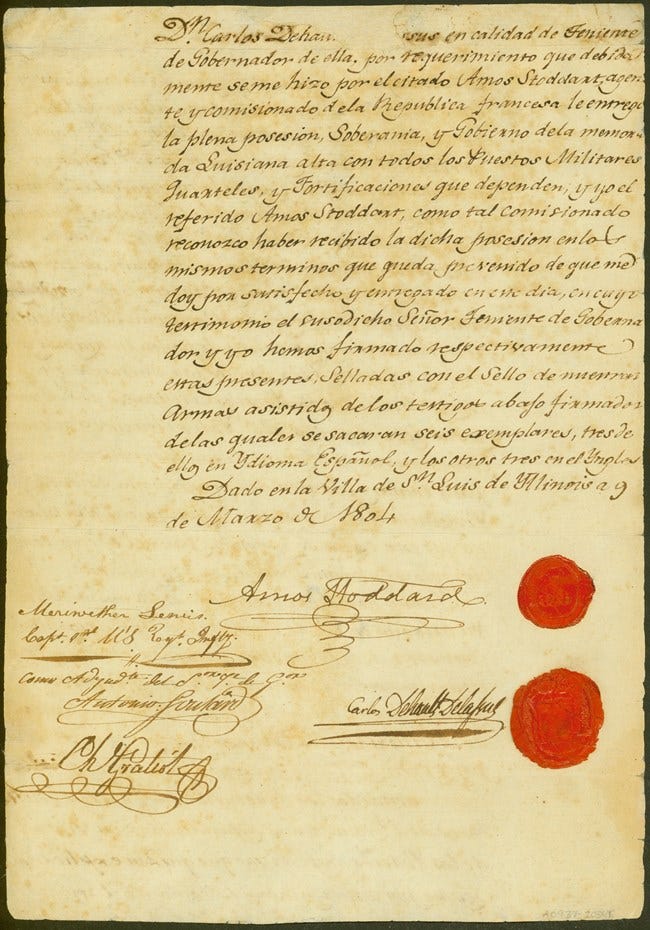
Louisiana Purchase Transfer Document (Missouri Historical Society, St. Louis, Louisiana Purchase Transfer Collection)
Fascinating case, great read!