
Roger Fisher and William Ury, with Bruce Patton · Houghton Mifflin, 1981 · third edition, Penguin, 2011 · 200 pages
Stefan’s take
Written 45 years ago, Getting to Yes is still the best first book on negotiation. The Harvard Negotiation Project turned the field into a teachable professional discipline. Fifteen million copies later, the field has moved on and matured, and the text is most confident where its critics turned out to be right. To get a solid introduction in one evening, look no further than this classic.
Read this if
You keep getting entangled in arguments that boil down to who holds out the longest, and you want a method that settles them on something other than stamina.
Don’t read this if
What stops you at the table is emotional — a counterpart who feels cornered, seems insulted, or would lose face by agreeing with you. On those topics, the book has four good pages and refers you elsewhere.
Where this book will be useful
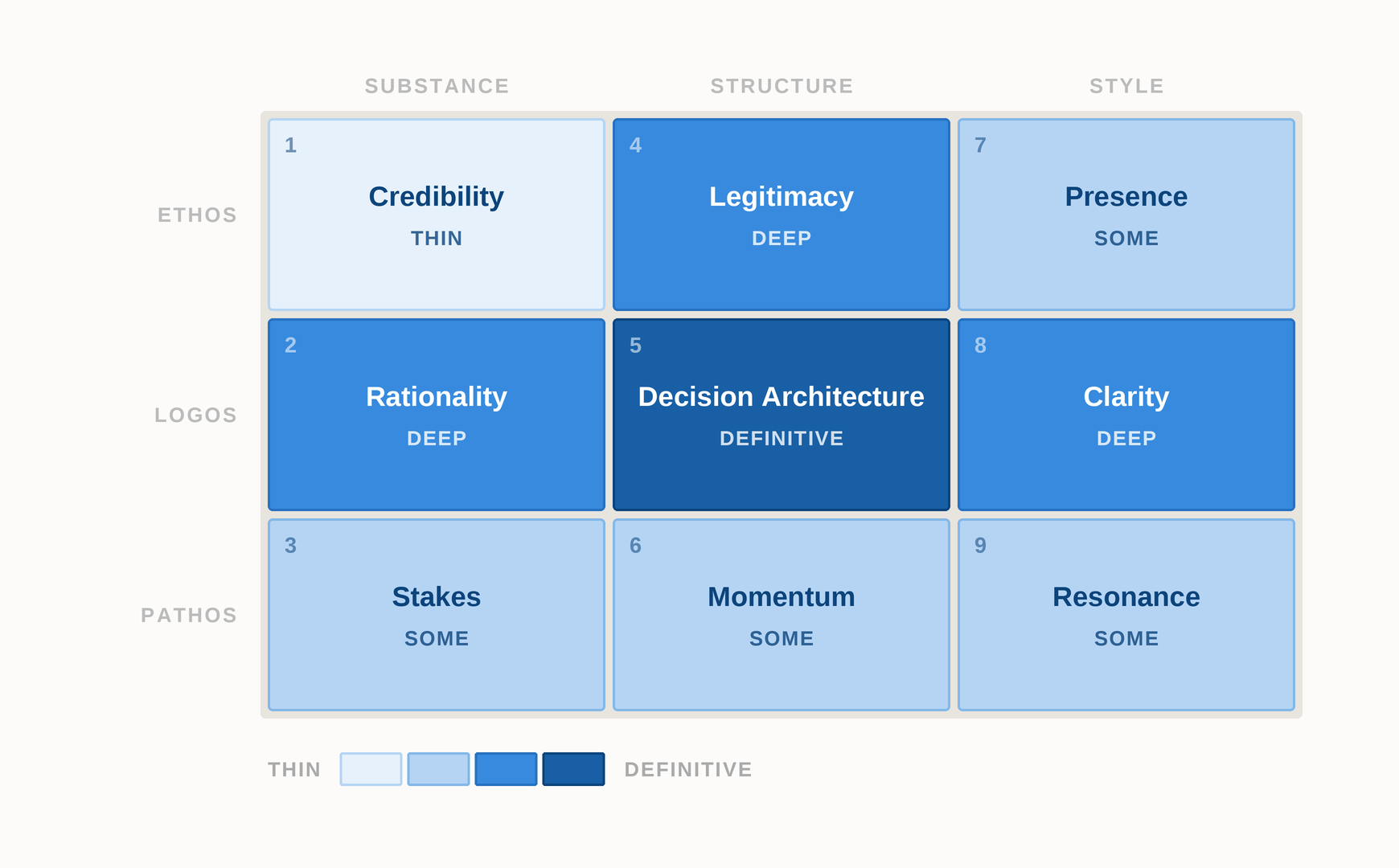
A full map means you’re holding a handbook or complete encyclopedia. One or a few dark cells show you where this went further than the field. Look for where the peaks are, not how much is colored.
The shape: the middle row is the book. Fisher and Ury brought logic to a subject that was managed on instinct. Trust and character get little coverage. The person on the other side of the table gets a chapter — not as a party to be moved, but as an obstacle to be cleared by rational means.
What it argues
Most people negotiate by staking out a position and defending it. The authors open by arguing that this method fails on its own terms. Positions harden as they are defended, egos entrench them further, “saving face” becomes a separate interest, and the result gets decided on stamina rather than merit. Their example is the 1961 test-ban talks between the United States and the Soviet Union. Those broke down over whether there should be three on-site inspections a year or ten — while, they note, nobody had established the meaning of “inspection”. One person for a day? A hundred people for a month?
The alternative approach they suggest has four parts. Separate the people from the problem. Focus on interests, not positions. Invent options for mutual gain before deciding. Insist that the outcome rest on some objective standard instead of either side’s say-so.
A fifth idea, introduced in the chapter on what to do against a stronger opponent, gave the field its most durable piece of vocabulary: BATNA, the Best Alternative To a Negotiated Agreement. It is, they rightly argued, the only sensible thing to measure any offer against.
The Fisher and Ury method is an attempt to get the outcome decided by something other than willpower. Read that way, its famous first step to “separate the people from the problem” stops sounding soft. The authors considered replacing “separate” with “disentangle” in the third edition, because readers kept confusing the phrase with “ignore all the human stuff and be rational”. That goes directly against the book. “Negotiators are people first”, it says on the second page of that chapter.
What it gets right
The chapter on objective criteria is the best part of the book, even if that is not what its reputation rests on. The argument is that you should negotiate the principles before you negotiate subject matter. Agree on how the question ought to be decided, and the answer becomes an exercise rather than a contest. Fisher and Ury are stronger on getting a standard onto the table than on choosing between two good ones. Where neither standard is more applicable, they fall back on trade-offs, an arbitrator, or splitting the difference — the very move the book spends four chapters arguing against.
Agree first on principles. Before even considering possible terms, you may want to agree on the standard or standards to apply.
Chapter 5, “Insist on Using Objective Criteria”
The book drills down on the mechanics. Ask “How did you arrive at that figure?” of any number offered without one. Treat every standard the other side proposes as a lever: explaining their own standard costs them no face. Argue like a judge with a stake in the outcome. You may want your own standard to prevail, but you must be genuinely willing to be talked out of it.
They offer the example of one Tom Griffith, negotiating with an insurance adjuster over a destroyed car. He makes no demand other than “whatever I’m entitled to under the policy”. The adjuster opens with $13,600. Griffith doesn’t counter, but has the adjuster assemble the figure out of his own blue book, line by line: mileage, technology package, autodimming mirror. He leaves half an hour later with $18,024.
The one-text procedure gets four pages and could carry a book of its own. Instead of trading proposals, one party produces a single draft nobody is committed to, invites criticism, revises, and repeats until the text can no longer be improved. Then everyone gets one decision to make: yes or no. It works because criticism is easy and concessions are hard. A process built on criticism doesn’t require any participant to be seen as backing down. At Camp David in 1978, mediating between Begin and Sadat, the Americans ran twenty-three drafts over thirteen days to converge on an agreement. A mediator or agreement-focused participant doesn’t need anyone’s permission to start; all it takes is writing a draft and asking all parties what is wrong with it.
The BATNA chapter is short. It does more work than most whole books. A bottom line, the authors argue, is a number you invent before you learn anything at the table, and then refuse to move. Any information or insights emerging during discussion are wasted on it. A BATNA is different. It is a fact about the world, what you will actually do if there is no deal. Any proposal, no matter how creative or unexpected, can be evaluated against it.
The chapter on dirty tricks reframes them usefully. Manipulative tactics “are illegitimate because they fail the test of reciprocity. They are designed to be used by only one side.” Capturing them thus under one shared principle, Ury and Fisher offer one simple counter: call out the tactic, and only accept it if the parties agree it will apply in both directions. That will work on a counterparty who needs deniability. It won’t on one who doesn’t care.
Hidden gems
The trip wire. A bottom line and a trip wire are the same sentence (“Don’t go below X”) doing different work. A bottom line ends the negotiation; the trip wire triggers a time-out. If discussions continue to your BATNA, the negotiation has reached the point you’ll walk away to your alternative. There’s nothing left to repackage or hand a mediator. Define a modestly higher warning marker and you can force yourself to reconsider — or consult back with your principal — while there’s time left and some room to maneuver. It gets half a page in a book of two hundred.
The reciprocal application test. Before accepting any standard or procedure, ask whether the counterparty would accept it applied to themselves. “If a real estate agency selling you a house offers a standard form contract, you would be wise to ask if that is the same standard form they use when they buy a house.” The counter to dirty tricks is equally useful in testing bona fide standards.
The case against it
James J. White, reviewing the book in the Journal of Legal Education in 1984, argued that Fisher and Ury “seem to deny the existence of a significant part of the negotiation process.” His critique related to distribution: when interests have been reconciled and acceptable options developed, somebody has to capture the surplus. The book offers little beyond the hope that a standard will turn up. White’s sharper worry was pedagogical: teaching students that the encounter is fundamentally cooperative risks disarming them against counterparties who aren’t.
The second line of attack came from someone who had spent a career in British industrial disputes, an area where structural power determines outcomes. William McCarthy, in the first issue of Negotiation Journal in 1985, granted the BATNA insight and then asked the question the book never does: what makes an alternative strong in the first place? Capital, incumbency, political cover, the ability to wait. Getting to Yes redefined “who has power” as “who has the better alternative” — but then never went on to answer the question.
The third is cultural. The Harvard method assumes a negotiator who is direct, comfortable making reasoning explicit, and willing to treat a standard as binding. That describes some but not all negotiating cultures. The book acknowledges this and warns against stereotyping individuals. The instinct is right. Nothing in the text suggests how to act on it.
The book’s own defense is better than most of its defenders’. The authors conceded the limitations in writing: “In single-issue negotiations among strangers where the transaction costs of exploring interests would be high and where each side is protected by competitive opportunities, simple haggling over positions may work fine.” They also refused the moral high ground the critics attribute to them. “Getting to Yes is not a sermon on the morality of right and wrong; it is a book on how to do well in a negotiation.” And they said plainly, in the preface to the second edition, that “more extensive treatment of some topics will have to await other books,” naming power and cross-cultural transactions among them.
Ury and Fisher are not blind to what they leave out. Their focus is on the problems in the middle row of our map. Other patterns need other books, and many have meanwhile been written, built on this one’s frame.
How to read it
Which edition: any after the first. The second edition (1991) leaves the original text almost untouched and adds a chapter called “Ten Questions People Ask About Getting to Yes.” The third (2011) refreshes the examples and adds a few pages on email and texting. The 1981 original is the least useful version.
Read chapters five and six first — objective criteria and BATNA. They are the book. Ninety pages in, they sit behind the three chapters the book is most famous for.
Then the one-text section of chapter seven, and chapter eight whole if you deal with hard bargainers.
Chapters two, three and four are the famous ones, and the most thoroughly absorbed into everything written since. If you have worked in an organization in the last thirty years, you have already encountered most of their content; skim.
Do not skip the Ten Questions chapter at the back. It reads like an appendix but it is the most operational writing in the book. It covers first offers, how high to open, how to move from options to commitment, and when not to negotiate at all.
Read it with, and instead of
For difficult and impossible counterparties: the authors themselves send you elsewhere. The endnotes on emotion and identity point to Fisher and Shapiro’s Beyond Reason and to Difficult Conversations by Stone, Patton and Heen. One is written by this book’s lead author, the other by its third. Read one of them if your problem is a counterparty who cannot be seen to lose face. Chris Voss’s Never Split the Difference is another source to complement this book with an emotion-based toolkit.
For value distribution and endgame convergence: Thomas Schelling’s The Strategy of Conflict, which this book cites and doesn’t attempt to replace. Schelling is where the commitment tactics come from. Fisher and Ury teach you to take will out of the negotiation. Schelling shows how to make your own will impossible to remove — the driver who throws his steering wheel out of the window. The opposite solution to the same problem, and both can work.
★★★☆☆ For reading pleasure and rigor
You don’t read Getting to Yes for fun. It takes you to and through the ideas without entertaining detours. Still, as efficient texts go, the prose is an achievement of an underrated kind. Chapters open on a scene, state a principle, illustrate it once, and stop. You can read the whole thing in a few hours and keep quoting from it a decade later. Little in the field does that better.
The evidence is another matter. The cases are illustrative, not deep. Anecdotes arrive compressed, often without names, dates, or any way to check them. The dozen endnotes in the third edition mostly refer to other books, not sources. Historical material is real and well chosen: Camp David’s twenty-three drafts, the Law of the Sea procedures, the 1961 inspections breakdown, Lord Caradon’s two-day delay behind Resolution 242. White’s complaint that the book is anecdotal rather than analytical is an accurate description, but an unfair indictment. The book doesn’t pretend to be anything it is not.
★★★★☆ As a practitioner’s tool
It’s being picked up to this day because nothing beats it as a first manual. The method goes a long way and fits in four imperatives. The BATNA chapter alone is worth the price. The Turnbull dialogue in chapter seven supplies phrases you can use the next morning (“Please correct me if I’m wrong.” “What’s the theory behind your figure?”). The one-text procedure is practical and effective for whoever has responsibility to produce an end result.
Two things keep it off five stars. It underequips you for the situations its critics named: hard distributive endgames, counterparties with structural power who profit from not playing, and people too threatened to be moved by logic. It’s great for new negotiators but will also teach them just enough to be vulnerable to a different breed of counterparty.
Then there is the problem every founding text eventually has: it becomes universal. BATNA is now taught in every business school on earth. It still pays to go back to the source and read up on the specific moves and execution detail. Four decades later, nobody does better in less than 200 pages, which is a strange thing to conclude about a book from 1981.