
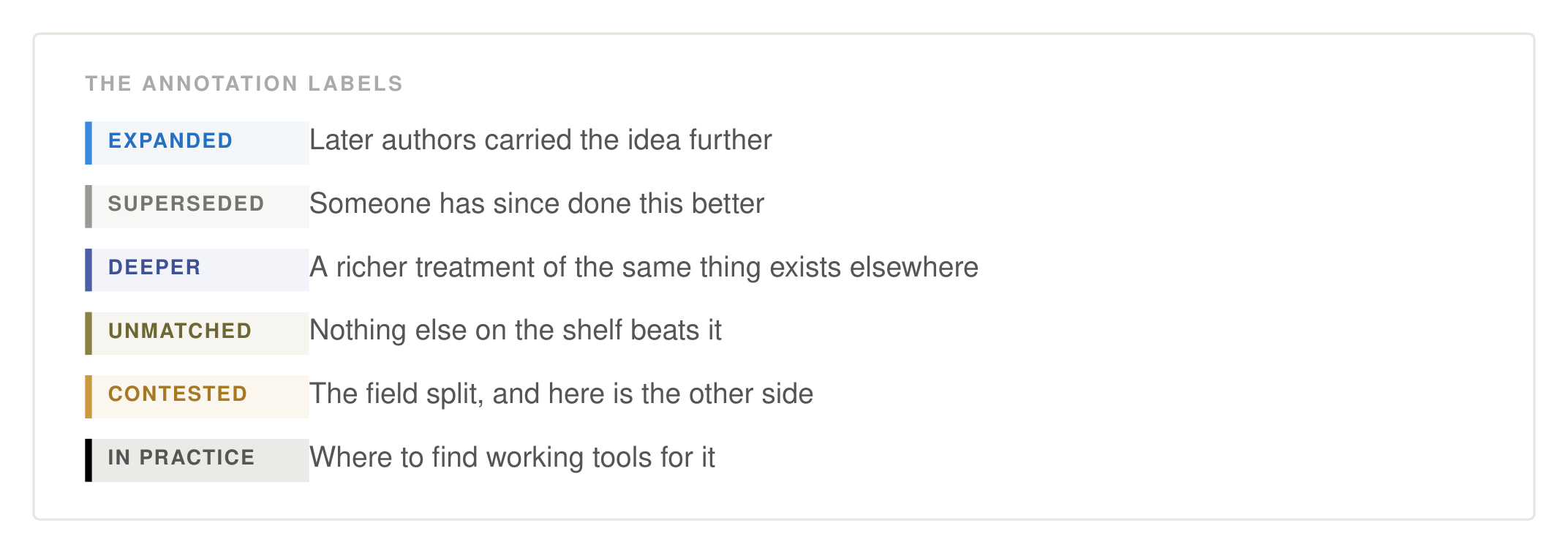
About this document. This is a detailed but entirely AI-automated annotated book summary. The running text gives you the ideas, logic and examples of the book itself, chapter by chapter. The tinted blocks are our NPL annotations, comparing the material to other works in negotiation literature, orienting on which topics this goes deeper (or is unmatched) but also where other works cover the topic better. If you only want the book summary, skip the tinted blocks. If you only want to study best in class ideas, use the guide at the end on what to read and skim.
If you read nothing else
Every negotiation is two negotiations at once. One is visible and concerns the money or the schedule. The other is conducted alongside it, mostly without words and usually inside the stands people take on the issues, and in it the two parties settle whose needs command attention, whose opinions count, and how cooperative either of them intends to be. That second exchange has a momentum of its own, unrelated to the substance, and whoever comes off worse in it will come off worse in the first one — often before an offer has been made. Two capabilities decide it. Advocacy is the work of making your own claim stand up: preparing well enough that you do not concede in your head before you arrive, making the value of what you do visible to the person who has to pay for it, securing the authority nobody handed you, and deflecting the moves that try to turn you into the issue. Connection is the work of getting the other person’s version of events into the room: not listening technique and not a softening tactic, but the working assumption that his behavior makes sense from where he is standing and that you cannot solve the problem until you know how. Advocacy alone buys an agreement that costs more to enforce than it was worth. Connection alone is capitulation with better manners.
Chapter by chapter
1 Every negotiation has a second table
Introduction. Kolb and Williams call the second track the shadow negotiation. It is where bargainers “decide between them whose interests and needs command attention, whose opinions matter, and how cooperative they are going to be in reaching an agreement.” It is “often nonverbal and masked in the stands taken on issues.” And it “has a momentum all its own quite apart from the substance of what is being discussed.”
Their opening case is two physicians at a suburban Atlanta health plan dividing vacation weeks. Will raises his claim in passing, with no warning, phrased as a statement of fact rather than a request. Elizabeth, given nothing to push against, begins generating compromises on her own — “in a way, her flexibility feeds his intransigence” — and the two of them end up settling a professional disagreement on a coin toss. She wins it. Will’s trip is then rescheduled for unrelated reasons and he never mentions this to her. The authors replay the same conversation with one change: Elizabeth declines the frame Will has offered, and follows immediately with a conciliatory overture, because what she wants from him is participation rather than surrender.
Contested
Fisher and Ury’s first rule in Getting to Yes (1981) is to separate the people from the problem, so that the merits can be argued cleanly. Kolb and Williams reply that the people frequently are the problem, and that the relational track is where the outcome gets set. Neither position has given ground in the two decades since. A reader who has only one of these books will mistake a contested question for a settled one.
2. The standard advice assumes a counterpart you will not get
Introduction. Mutual-gains advice assumes you can focus on the problem, that you know what you want, that both sides are willing to negotiate, and that a creative idea will carry the day. Each assumption is tested against what their interviewees actually reported. On the first: “you cannot take the people out of the problem. Sometimes people are the problem.” Objectives shift mid-conversation, and even bargainers who define one precisely miss its scope: delighted at winning a promotion, “they overlook the conditions — reduced workload or increased resources — necessary to make a success of that new job.” Self-interest is not always enough to bring a counterpart to the table at all. And “rationality and objectivity, however, do not always rule at the bargaining table.”
The demonstration is the field’s most-repeated teaching example, turned around. Two sisters want one orange; one needs the rind and the other the juice; the trade is available to anyone who asks the right question. The authors grant all of it and then itemize what the story has quietly removed. The sisters have “the luxury — not often found in actual negotiations — of getting right to problem solving.” The fit is “almost mythic in its symmetry”: no overlap at all in what the two of them need, and change one recipe so that it calls for both rind and juice and the answer disappears. And the quarrel “could mask resentments that have nothing to do with oranges.”
Contested
Bazerman and Neale reach the same verdict on rationality from the opposite direction. Negotiating Rationally puts the failure in cognition rather than in the relationship: anchoring, escalation of commitment, and above all the fixed-pie assumption, which their experiments show survives being explained to the people holding it, so that both sides routinely sign terms both would have preferred to change. Go there if you want the departures from rationality catalogued and measured, because they are specific enough to prepare against one at a time. Where these authors would have you connect, Bazerman would have you install a procedure that works on a negotiator who cannot be talked out of the bias.
3 Don’t throw in your own windows
Chapter 1. “Acts of self-sabotage often do more to harm a bargainer’s position than the other side’s tactics even contemplate.” Seven ways it happens. Treating an offer as a fait accompli and never negotiating the conditions you need to deliver on it. Disliking the process. Reading only your own weakness. Overconfidence. Needing everyone to be happy. Confusing toughness with effectiveness, which gets a lawyer removed from her management committee before she signs the clause she was fighting anyway. And bargaining yourself down. “Once you make that first concession in your head, you lower your aspirations and lose ground before the negotiation even opens. These diminished goals become self-fulfilling prophecies.”
Four preparatory tasks are the repair: take stock, learn what you can, develop alternatives, get somebody else’s eyes on it. Taking stock is four questions: why is this person negotiating with you at all, what happens on the occasions when you have succeeded, what do you know about the other party, and where are you exposed. Learning divides into the factual and the political. People skip the political. An industry survey answers a boss operating on a gut reaction. Only asking around discovers that the real objection to a flexible schedule is visible hours in the building, which is a different proposal.
The running case. A tenured professor is told she has been elected department chair, days before an adopted baby arrives and a first book is due. She decides to resign. A friend asks at what price she would take it. She inventories what she is worth to the department, finds out what chairs elsewhere are given, arranges a co-chair as a fallback, and asks for one fewer course and an assistant. “Brad did not even blink. He was perfectly willing to bargain.”
Deeper
Alternatives get three pages here and the acronym is borrowed from Fisher, Ury and Patton, who are cited in the notes. Chapter six of Getting to Yes builds it. Your alternative is the only legitimate measure of any offer on the table, which converts “am I in a strong position” from a feeling into a comparison you can perform in the room. It also supplies the discipline these authors are reaching for in the bargaining-yourself-down passage: never measure an offer against a number you invented before you knew anything.
4. Negotiating at all is an admission of need
Chapter 2. “A willingness to negotiate is at some basic level a confession of mutual need.” Where the need looks one-sided, the shadow negotiation tilts. Five classes of move correct the tilt: hold out incentives, step up the pressure, establish your authority, enlist support, exert control over the process. The third has a section to itself and is taken separately below.
Incentives start with having something the other person needs, and continue with making sure he knows it. “When your work disappears, so do your influence and your bargaining power.” One art director, tired of a boss who conducted salary talks from behind a vast desk while the supplicant sank into a low couch, brought a high stool from the studio and looked down at him; scheduled the meeting for the newsroom’s deadline hour; let the producers interrupt; and walked out, which brought the secretary after her and the boss onto the couch saying let’s talk money.
Pressure is for the counterpart who is content as things stand. Abba Eban on diplomats and their “passionate love affair with the status quo.” Issue a threat that costs something: a travel agent indifferent to a consumer-protection complaint is not indifferent to referral business, or to a fiancé who knows the paper’s travel editor. Force a choice: an outside offer with a deadline gives a manager who never makes waves both the prod and the justification to argue on your behalf. Make consequences tangible: list your projects and their due dates on a whiteboard, and ask which one he would like dropped.
Support and process control are the quiet two. An associate dean who sponsors a job-share proposal gets it heard where the person asking would not, and can deliver the resignation warning that the applicant could never make stick herself. A new hospital head sequences her one-on-ones, the most supportive player first and the head of surgery last, with the nursing burden negotiated down before she ever meets the head of nursing. Neither move is visible in the room where the decision gets taken.
Deeper
The pressure moves work in the cases and the chapter never says why any particular threat is believed. Schelling’s The Strategy of Conflict is the book that answers it: a threat is credible in proportion to how much of your own freedom you have destroyed in making it. That is the difference between the travel agent, who can see exactly which of his interests is exposed, and the ultimatum that gets nodded at and ignored. Read it if your threats are being treated as opening positions.
5. The mandate has to be won twice
Chapter 2. The strongest section in the book. Negotiating on someone else’s behalf exposes you on two fronts at once, and doubt on either side of you travels quickly to the other. Across the table, secure the authorization explicitly and in writing. A young manager is sent to unwind her employer’s stake in a coal venture that has gone bad, facing a bank chairman and a company president and “young enough to be their daughter.” She drafts the letter herself for her chief executive’s signature: she knows the partnership best, she has the full confidence of the board, she has complete authority to act. The coal president calls the chief executive directly anyway. “The CEO simply referred back to ‘his’ letter.”
Behind you, the backing decays. One manager’s boss enjoyed talking fiber technologies with the contractor and took his calls. The contractor used exactly that to cut her out. Another negotiator’s own staff feared she would be outmatched. The doubt reached the other side through the grapevine and licensed their lead negotiator to dismiss her, and she repaired it on both fronts at once: an advisory group with a representative from every department, and a direct question to the managing director about who had the last word. “An ‘official’ assignment does not automatically convey the backing necessary to carry it out.” The chapter closes on a banker’s phrase for the whole problem, the persistent need to “prove up”: with each promotion the credentials have to be established again, in front of people who were not present the last time.
Deeper
That letter is an improvised full power (the instrument that states in set terms what an envoy may agree to on his sovereign’s behalf, issued in more or less that form since the seventeenth century). Satow’s Diplomatic Practice codifies the tested version. An improvised letter does not anticipate the distinction between authority to negotiate and authority to sign, which is where a counterpart who cannot go around you goes instead, at the end. Satow also gives the procedure for challenging an instrument mid-negotiation, and documents how deliberately a principal narrows the mandate he issued. These authors describe the same decay behind the table, without a name for it.
6. Turn the move, not the person
Chapter 3. The reliable counter-move to anything you do is a claim about you rather than about the deal. “The mere suggestion that you are controlling, incompetent, selfish, or manipulative clouds the issues. But, even more important, it puts you on the defensive.” Denying it keeps the conversation on what you are or are not. Answering in kind rarely changes a mind and can start a contest of wills. The third option is the turn. “Responsive turns are acts of resistance, not reaction. Turns redirect the negotiation by reframing what is happening.” The authors are explicit that none of this implies bad faith on either side: bargainers test each other constantly.
Four of them. Interrupt breaks the timing. A new committee chair meets a rival’s four-page memo with “what a lot of work” and an offer of more coffee, then tables it rather than killing it, which tells the other members that no one person will run the sessions. Name attaches a label to the behavior and never to the person. Charlene Barshefsky, then the U.S. trade representative, was told across the table in the intellectual-property talks that the offer was take it or leave it. She waited almost a full minute. “If the choice is take it or leave it, of course I’ll leave it. But I can’t imagine that’s what you meant.” Correct substitutes your account for theirs: a banker told her people skills were not enough for commercial lending answered all the questions he had failed to ask, starting with teller turnover cut from 82 percent to 15 and a million dollars saved on renegotiated insurance in the second year. Divert moves the subject from the person back to the problem. Accused of empire building, ask instead why the coordination procedures between departments are not working.
Unmatched
Nothing else on the shelf supplies this. Advice on handling a hostile move is abundant and it divides, almost without exception, into ignore it or answer it — the same two options these authors reject in the first paragraph. The turn is a formal category rather than a tip: an act aimed at the move and not at the mover, which redirects without either conceding the characterization or contesting it. Voss’s labeling comes closest, and it attaches to emotions, not to tactics. Blount handles objections, which are claims about the deal itself. This is the contribution most likely to still be standing in twenty years, and the least likely to be attributed to this book, because the four turns are usually encountered as loose folklore about staying calm.
7 Silence ratifies
Chapter 3. The sharpest passage in the book. Standard advice on heavy-handed tactics is to “take the high road and refuse to participate on the same level.” For one class of move, the authors argue, the high road ratifies the insult. That class is “the explicit use of raw power to dominate,” the move whose content is a characterization of you. “If, as common advice suggests, bargainers opt to take the high road and ignore the demeaning behavior, they may reinforce the very stereotyped perceptions they need to turn. No response is a response. Unless contested, the label sticks.”
They are equally clear that the response is hard to calibrate (too much disruption keeps the attention on your reaction, too little and the censure goes unnoticed), and that these situations allow no preparation time, so the repertory has to be ready in advance. The illustration of the move itself is Lyndon Johnson conducting a policy discussion with senators from the toilet, a location chosen to establish that he could talk whenever and wherever he chose. The most famous of their counter-examples is Dot, who ran workouts for a money-center bank and was the only woman in a debt restructuring, “a nobody, a phantom on the sidelines.” She produced a bottle of red nail polish, began lacquering an already perfect manicure until the room went quiet, then looked up: “Any time you’re ready, boys.” They immediately take the story back a step. “Dot’s turn cannot be separated from her position.” Performed by someone three years into a career, the identical act “is likely to be interpreted as poor judgment rather than ironic commentary.”
Expanded
Voss solves the calibration problem these authors name and leave open. If an uncontested label sticks, and contesting it in the moment is a matter of judgment under pressure, the way out is to say it yourself before anyone else can. That is the accusation audit in Never Split the Difference: you open with the worst thing the other side could say about you, stated flatly and without defense. It converts an improvised turn into a prepared line. By the chapter’s own account these moves arrive without warning, so a prepared line is the only kind you will actually have.
8 Preparation makes you deaf
Chapter 4. Part Two opens by turning on Part One. Building your own case single-mindedly installs a script that filters everything said afterward. “A certain deafness sets in. We edit out what we don’t want to hear and listen to what is said with a fixed script in mind. We make attribution errors that have us ascribing good intentions to ourselves but not to others. We create self-fulfilling prophecies.” Assuming the other party will act as you would in his position is given the State Department’s name for it, mirror-imaging.
The corrective is to treat the negotiation as a set of competing accounts rather than a set of facts, because “stories don’t trade in certainties. They deal with ‘maybe’ and ‘what if,’ not statements of fact.” The instrument is a three-stage questioning exercise, adapted from Sara Cobb and credited in the notes. An account manager whose creative director has gone around her to a client leaves an urgent voicemail, then works through it: her own version first, in full and with the anger intact; then his, constructed step by step — “if I really liked my design, I’d be tempted to give it one last try... Maybe he thought I was new on the account and needed some help”; then the connections between them. The payoff is four lines when they finally speak. “You must have been disappointed about the first tape.” “Disappointed doesn’t begin to describe it. I was furious. That’s why I called the client — to give it one last shot.” “That’s what I figured, but it took some effort to get me there. Next time, let’s talk first, okay?”
Contested
The field splits here on what preparation is for. Lax and Sebenius argue in 3-D Negotiation that the decisive work happens before anyone is in the room and that there is no such thing as too much of it: who is at the table, in what sequence they are approached, what each of them does if there is no deal. These authors have just described thorough preparation producing a specific pathology. The two are arguing about the object rather than the quantity: 3-D prepares the structure surrounding the conversation, which no amount of scripting can make you deaf to, while the deafness described here comes from rehearsing the conversation itself. Keep both; only one of them will tell you who should be in the room.
9 Show them you heard it
Chapter 5. This chapter is about the signals that tell a counterpart his account has registered with you. It is built around a public failure to send any, returned to five times: the 2001 rupture at Boston’s WBUR between the station manager and the host of The Connection, reconstructed from press coverage and the principals’ circulated memos, with the authors stating in the notes that they interviewed neither. The host wanted half of all new revenue from the program. “Mary McGrath and I see ourselves as Venture Broadcasters, not as Employees... It’s about equity, about sharing risks and returns in this little startup of ours.” The station’s counter would have made him the highest-paid personality in the public-radio system, above the network’s chief executive and above the station manager herself, and he turned it down. The diagnosis: “at every point he rebuffed conciliatory overtures or sent mixed signals,” and he positioned the station as an opponent rather than a party he was working with.
Against that, appreciative moves in four registers.
The situation. A marketing director met with hostility at a language school asks for a tour of the branch before raising her subject, and learns that no Mexican appears anywhere in the teaching tapes at a center serving Mexican immigrants. The feelings. This does not require discussing them: one negotiator, reading the postures and the perfunctory greetings in the room, simply left the two forms in her briefcase. The ideas. Deborah Tannen’s cooperative overlapping, in which “opinions are considered in relation to one another and get revised as the participants make new contributions.” The face. Goffman is cited by name: a director backed into a corner over unreimbursed travel is given an intermediary so that she never has to concede her original position was wrong. “The researchers were reimbursed for all their expenses by month’s end, but I never knew where the money came from.”
A counterpart who reads the move as a maneuver ends it. One venture capitalist, warned by her boss against being “profligate with emotional capital,” abandoned the attempt and took the other side to court. Then the chapter states the cost with unusual candor. “Bargainers with the least power are almost always the ones who pay the most attention to the other person’s feelings and opinions. There is little reciprocity... Connection, in fact, has been called the weapon of the weak.” Their answer is that connection can also create power where there was none. The imbalance is conceded rather than explained away.
In practice
The four registers are a diagnosis and the reader still has to produce the sentence. Working forms for each register are in the guide to Responsiveness, including what to do when the appreciative move is read as a maneuver. The chapter reports that failure without solving it.
10 Collaboration runs on work nobody counts
Chapter 6. Two failures are named first: the concession dance, which produces “competing monologues,” and problem solving that stalls because symptoms are being mistaken for causes. Mary Parker Follett is quoted against both: “I never react to you but to you-plus-me... In the very process of meeting, we both become something different.” The chapter’s own contribution is the “invisible work” of getting a negotiation into a state where collaboration is possible at all, broken into four tasks.
Make room for relationship building. A manager walks to the research lab rather than scheduling meetings, and reads the cryptic messages and charts on the walls to tell her when she can push and when to wait a day. Rituals belong here, from garment-industry dinners before bargaining opens to a Capitol Hill official’s Saturday coffee and donuts: “it doesn’t matter what the food is... In my experience, those confidences change the dynamic in the room. Not 100 percent. But they help.”
Encourage participation. An acquisitions lawyer opens every conference call by asking each person where they think the deal is coming out — “I guarantee those are all different right now” — on the principle that sharing information is itself an act of trust. Keep the dialogue going. In one biotech negotiation the decisive change had nothing to do with money or ownership; it was a standing Friday lunch, after which the other side volunteered the terms originally asked for. Get everyone to own the problem. A manager forbidden to add head count builds his charts and then asks for help rather than for resources, and the division manager produces the contracting solution himself.
Deeper
Every case here has two parties, and participation is arranged by intuition and personal knowledge. Susskind’s Environmental Diplomacy does the same work as design, for the case this chapter never reaches: who has standing to be convened, how a representative’s claim to speak for a constituency is verified, and the facilitated single text that keeps a conversation moving when the parties will not talk to each other. Go there before your third party joins, since the informal version of this work stops scaling at exactly that point.
11 Push, package, inquire
Chapter 7. Which of the three models you are in is partly your choice and partly imposed on you.
Pushing is their word for the win-lose case: “you are adversaries not because of how you feel about each other but because of the structure of the negotiation.” An architect outlasts a contractor over two hours on a $140,000 gap, knowing he needs to keep his crews busy in a slow season. She names the price of winning that way afterward: “that extra supervision time was the trade-off I made when I pushed only on price.” Packaging trades on differences. Follett’s library window, opened in the next room where nobody was sitting, is quoted at length: “This was not a compromise. We both got what we really wanted.” A departing employee offers to stay three extra months and build a transition plan in exchange for his boss conceding severance eligibility. The authors are candid about the limits: “just coming up with a package deal does not ensure that the other party will agree. The elegance of the solution may not be enough.”
Mutual inquiry is the third and the one they claim as their own. The relationship changes during it rather than being a precondition, and “new ideas don’t come from brainstorming, as in problem solving, but from listening, learning, and creating together.” The set-piece runs one negotiation three times: a Washington think tank against the contractor who teaches its seminars. Pushing produces no new program and more sessions of the old one. Packaging produces a revenue ratchet that works, but leaves both sides preoccupied with who gets what and when. Mutual inquiry produces the actual answer, after the client asks the contractor to explain his business and learns that he needs 105 attendees a session and can only reach the existing alumni pool: a two-day course bolted onto the introductory one, creating “instant alumni” on the first evening. It played to sellout crowds.
Expanded
Packaging arrives here as something you improvise once the positions are on the table. Dietmeyer’s Strategic Negotiation moves the same work to the front: the criteria and their relative weights are elicited from the counterpart before anything is priced, so the package that emerges is one he has already told you how to build, and the number is an output of his own stated preferences rather than a proposal he gets to evaluate cold. Go there if elegant packages keep getting refused.
12 Settle the process first, and open the books last
Chapter 8. One case, sustained for a chapter: a hotel executive of twenty years’ standing, newly running the chain’s flagship property, facing her first union contract against two nonunion competitors in the same city and wanting performance-based pay, which the union rejects in the first session. Every move she makes is about process before substance. She widens her own side of the table to her advisory team over her labor attorney’s objection. She invites the union president for tea and cookies before formal talks open — his predecessor had gone for beers — and uses it to state her expectations and her boundaries in advance. She stays out of the early sessions deliberately, because “if I started inserting myself into the sessions right from the beginning, everyone would just wait for me to talk,” and sends her head of human resources to work the cafeteria grapevine instead.
Her one flip-chart session lays out three objectives and three options: performance pay, traditional hourly, or contracting the work out. The union hears a line in the sand, which horrifies her, and then the room responds to the straight talk rather than resisting it. The authors name the self-deception exactly: she fully intended to deliver a tough message and did not want to be seen as intractable. Voluntary work groups then build the formula and catch the flaw in management’s own opening proposal, that poor performers would gain more than good ones because they had more room to improve. Only once the principle is agreed does she open the books. “This is the pot of money we have. How do you want to spend it?” The timing is the lesson. Earlier, the leadership would not have believed the numbers were complete, and she would have handed them a lever. “Trust on both sides of the table was a precondition for her candor.” Her own closing verdict is against her instincts: “I take consensus to a fault... I now recognize that it’s not only okay to be tough, it’s actually necessary.”
Deeper
Iklé’s How Nations Negotiate names what the work groups are actually solving. What a negotiator can accept is bounded by what the people behind him will ratify, so a deal the union officers merely agree to is a different object from one their members have built. Go there for the accounting version: the constituency as a constraint you can measure and sometimes exploit, including the negotiator who is genuinely helped by being unable to concede. This chapter offers it as an instinct that turned out well.
Which chapters to read
Intro Read first Where the shadow negotiation is defined, and nothing after it makes sense without it. The two physicians and the replay are the whole method in six pages.
1 Read Preparation. The seven pitfalls run long and repeat each other; the four take-stock questions and the bargaining-yourself-down passage are what to keep.
2 Read first Five classes of move, and the section on establishing authority is the densest thing in the book. Most readers will find something here they can use this week.
3 Read first The four turns, then the demeaning-moves section, which is the sharpest passage the authors wrote and the one where they break with standard advice on purpose.
4 Skim Read the deafness paragraph and Figure 4.1, which is a usable exercise. The remainder restates the case for listening at length.
5 Read The public radio case is the most instructive failure in the book because it is documented rather than recalled. The weapon-of-the-weak paragraph is the most honest thing in it.
6 Skim Invisible work is a good name for a real thing; learn the four tasks. The cases are thinner than Part One’s and several make the same point.
7 Read Three models, and the same negotiation run through all three. The best worked comparison in the book, and the only place mutual inquiry is shown rather than described.
8 Read One negotiation end to end over months. The only place you see the sequencing. Read it after chapter two rather than last if you are short of time.
Notes Skim Unusually substantive for endnotes. The sourcing for circular questioning, the Barshefsky exchange and the research on aspirations is all back here, and nowhere in the chapters.
The takeaway ideas
The circular exercise
Before a difficult conversation, write out three things in this order and do not skip the first.
Your own account of what has happened and how you feel about it, in full, with nothing moderated for an audience.
His account. Not what you think he should say — what he would actually say, given what he knows and what his week has been like.
The links between the two: which of his actions your version has been reading as bad faith, and what else they could be.
The first stage is the one people leave out. Venting on paper empties the script that would otherwise be running while he talks. The second stage is where you discover that the person who went around you to the client thought you were new to the account and needed help.
Draft the letter yourself
When you are sent to negotiate for someone else, draft the letter your principal will sign. Three sentences: why you were chosen, that you have the confidence of the people who chose you, and that you have complete authority to act on their behalf. Circulate it before the first session. The point is not the letter — it is that when your counterpart goes over your head, and he will, your principal has something to refer back to instead of an improvised answer.
Then ask the question the letter does not settle. Go to whoever actually decides and ask, in those words, who has the last word. A negotiator who cannot answer that is one whose own side will quietly renegotiate the deal behind her, and the doubt reaches the other side of the table through the grapevine long before anyone says it out loud.
Two structures you are indifferent between
Where you would otherwise put a number on the table, put two ways of arriving at one, built so that you genuinely do not mind which is chosen: a sliding scale tied to results, and a fixed figure that costs the same in expectation.
It changes what the other person is doing. He stops evaluating your proposal and starts choosing between two of his own risk profiles. The question is now about his situation rather than about you, and he can answer it without conceding anything. The candidate who used it was told afterward that having two schemes was what let the decision get made.
This gives you a working repertory for the second track: how a negotiation gets decided before the numbers are discussed, what the moves and counter-moves look like, four ways to answer one without denying it or returning fire, and why the same tactic performed by two people produces opposite results. None of it is available in the books that dominate the field, which is why this one has kept selling for a quarter-century under two titles.
It does not give you anything on substance. This book has almost nothing on what a good deal is: no method for valuing what is being traded, no standard for testing whether an agreement left anything on the table, no account of how to construct a walk-away figure. It assumes you have that from elsewhere and it is right to, but a reader who takes it as a complete education in negotiating will be extremely well prepared for a conversation about a proposal he has not thought through. You also lose the texture, which is most of what three hundred pages of interview material is for: the seven pitfalls only land once you recognize yourself in the third one.
One limit will not survive any summary, including this one. The turns are position-dependent, and the authors say so once, in a single sentence about the nail polish. Read quickly, this is a book of moves anyone can make. Read carefully, it says the opposite — that which moves are available to you is set by where you already stand, and that the people who most need the repertory are the people it costs the most to use. The same is true of connection: the work of understanding the other side falls to whoever has less power in the room, chosen or not. Take the moves. Check your position first.
