
“Gersen turned away. “Odd. Why should anyone post so high a rescission fee? And I notice several other guests with similarly high redemptions. What is the story here?”
Koshiel licked his lips, blinked, looked furtively over his shoulder. “I should not impart this information since it concerns the identity of a sponsor, but I am sure this particular sponsor is quite indifferent. He is the famous Kokor Hekkus.”
Gersen feigned surprise. “What? Kokor Hekkus the Killing Machine?”
“The same. He has always given us a certain amount of business, but at the moment it seems that he dominates the entire enterprise. In the last two months, he has brought twenty-six items to Interchange, and all—save one—he values at a hundred million SVU. And in most cases he collects.”
Pop culture depictions of deals and negotiations are often caricatures; Jack Vance’s science fiction novel The Killing Machine (1964) on the other hand contains a delicate miniature. The plot involves a specialized market, brokered at a dedicated clearing house: the trade in hostages taken for ransom. In this scene, Vance’s lead man Kirth Gersen visits that institution, “Interchange”, as the agent of a wealthy father buying back his children’s freedom. Their 100 million SVU ransom is an impressive enough sum of money, but conversing with an Interchange employee Gersen discovers its most highly priced occupant is listed at an astronomical 10 billion SVU. The intrigue deepens when it turns out this 20-year old woman, Alusz Iphigenia Eperje-Tokay, has checked herself into Interchange at this price. She sees it as the only way to escape the reach of a suitor as persistent as he is unwelcome: Kokor Hekkus, one of the five “Demon Princes”, master villains Gersen wants to exterminate.
“So now! We have this ludicrous circumstance, the girl serene and secure in the Imperial Gardens at Interchange, while Kokor Hekkus sweats and reeks in the extremity of passion. And “indeed, he will not be denied. He lacks the cash; somewhere he must find ten billion SVU.”
“I begin to understand,” said Gersen.
“Kokor Hekkus is by no means baffled,” Koshiel declared with verve. “He fights fire with fire. The girl has used the appointments of Interchange to thwart him; he will use the same to gain his will. Ten billion is a large number, but it is only a hundred times a hundred million.”
For its deft depiction of realistic negotiation mechanics, the Negotiation Pattern Language endorses the book. At this early point in the plot, Gersen is no concerned party in the transactional case study he sees unfolding between the three others.
Interchange’s business model rests on Non-Arbitrary Procedure (4.2). Granted, its trade is illegal—but bear in mind their operation is physically located in the Beyond, the part of Vance’s universe beyond the reach of law enforcement. If kidnapping is going to be a business, it ought to be run by professionals. Interchange guarantees proper treatment of the hostages it hosts, and their prompt release if the ransom is paid. But like any good platform business it provides guarantees to the other market participants too. Interchange is not selling sanctuary. So when Alusz Iphigenia Eperje-Tokay tried to set a ransom of one thousand billion SVU, Interchange refused as a matter of policy, capping the amount at a more reasonable 10 billion.
Kokor Hekkus wouldn’t be much of a Demon Prince if he didn’t consider the obvious alternative: taking what he wants. If he concludes complying is the better route, it’s because he has a keen understanding of Collateral (1.3). Having established Koshiel as a useful character to explain what can’t be shown, Vance has him summarize why even Kokor Hekkus doesn’t dare thwarting Interchange: “First, he would never be allowed the use of its facilities; second, the Interchange management would spare no effort in punishing him.” It’s work, but wiser to just raise the money.
Alusz Iphigenia for her part adopted one of the more sophisticated moves in negotiation. Constraining your own freedom can turn a weak position into a strong one. Reversibility (6.3) is usually about preserving your options to go back. But visibly depriving yourself of any escape route also removes any option for the counterparty to pressure you. Once checked into Interchange, even she herself no longer controls her own freedom.
Vance was a widely read man with many interests. Though set far into an imaginary future, the move was part of the 1964 zeitgeist when he wrote The Killing Machine. Four years before this scene, it had been described by Thomas Schelling, an economist. Schelling was an academic before he turned practitioner, and a practitioner before he became a Nobel prize winning game theorist. After studies at Berkeley, he worked as staff economist for the Marshall Plan in Copenhagen in 1948, before moving to Paris and negotiating to set up the European Payments Union in 1950. In his European evenings, he wrote the dissertation for the Harvard doctorate on Keynesian macroeconomic models he obtained in 1951. In interviews Schelling credited his experience as a negotiator for the direction his later work took, expanding on ideas and topics in the field of game theory.
Game theory was established in the 1940s as a branch in abstract mathematics; Schelling connected it to the real world. He taught himself formal game theory largely from Luce and Raiffa’s 1957 Games and Decisions, then spent a year at RAND Corporation testing and developing the ideas on nuclear strategy questions. The Strategy of Conflict was published by Harvard University Press in 1960, two years before the Cuban Missile Crisis brought concepts like commitment, credibility, and brinkmanship into the mainstream media and everyday Cold War discussion. Schelling’s original idea was the power to bind oneself: “the power to constrain an adversary may depend on the power to bind oneself... in bargaining, weakness is often strength, freedom may be freedom to capitulate.” A party that visibly and irrevocably removes its own freedom of action forces the other side’s hand. Imagine, Schelling said, a game of chicken, with two cars speeding towards each other and one driver visibly ripping out the steering wheel and throwing it out the window. The other driver now has the richer set of options—but what else can he do than swerve?
With the RAND Corporation and Vance both located in the Bay Area, the basic concept must have circulated in his social circles. The author’s use of an intermediary institution is a creative variation. In spite of its long history, the idea of manufacturing strength out of weakness is nevertheless underappreciated and underexploited. A deliberately restricted agent mandate (4.1), as a device to increase the agent’s power, is still one of the broadly misunderstood concepts in negotiation practice. To be sure, many agents don’t want to understand it, preferring a broad mandate and an easier time in external negotiation over the hard work of delivering a better result on the back of a tighter mandate.
Mandate management aside, having an intermediary govern your self-chosen binding is difficult in the real world. Julian Assange tried it, using the Ecuadorian embassy in London as his Interchange from June 2012 to April 2019. The authorities were only a few meters away from the fugitive, but breaching through the diplomatic firewall to arrest him would have had intolerable consequences. Assange’s ploy worked as long as Rafael Correa’s anti-imperialist government granted him asylum, and for seven years he was beyond the reach of Washington and London. But Correa’s successor, Lenín Moreno, elected in 2017, was more interested in normalized diplomatic relations and he reversed the asylum grant. Ecuador itself was looking for a trade, to get out of the hands of China and private international bondholders: a $4.2 billion rescue package from the International Monetary Fund.
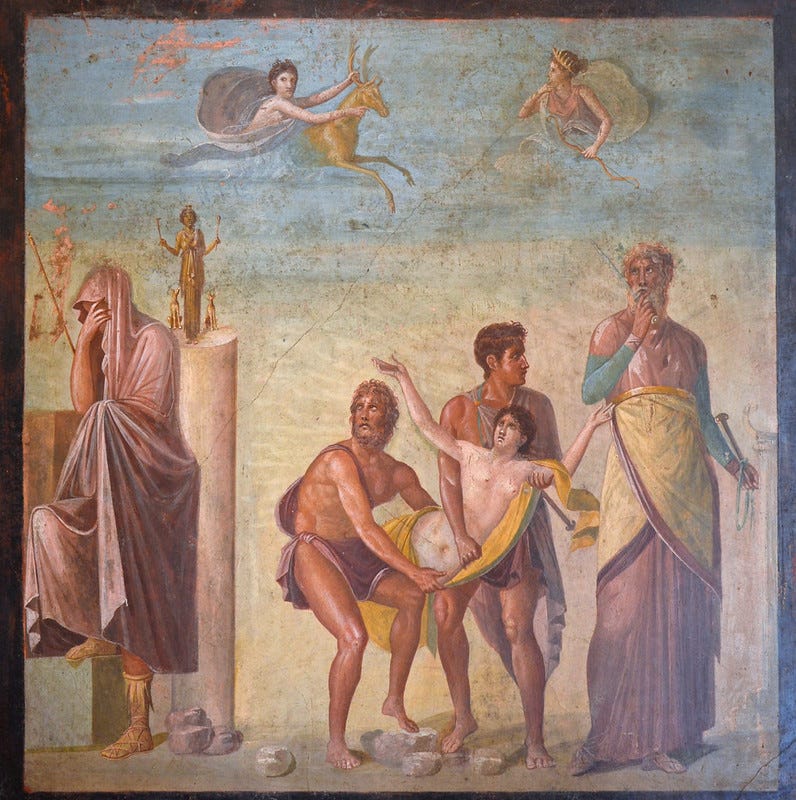
The Killing Machine doesn’t tell if Interchange is a longer lasting institution, weaving the narrative around Gersen’s pursuit of the criminal, and criminal’s pursuit of the woman. Vance seems to have conceived her as a cross between a fairytale princess and a mythological one. In Hungarian, “Alusz” refers to “sleepy”, and “Eperje” and “Tokay” to strawberries and grapes respectively. In Greek mythology, “Iphigenia” is the daughter of Agamemnon and Klytemnestra—narrowly saved from sacrifice, but permanently trapped as High Priestess in Artemis’ sanctuary where it is her fate to prepare her captured fellow countrymen for sacrifice. Read the book to find out if Vance gives his Alusz Iphigenia a sleeping beauty or Greek tragedy resolution to her Schellingian bargain with Kokor Hekkus.